
On this page19 sections
Key takeaways
- Is it legal? The app deals play chips. Real money moves between you and an agent outside the platform, in a legal grey zone. Minnesota was cut off in 2020.
- Is it rigged? There is no evidence the RNG is rigged: three independent labs have audited it. The real threat is the people at the table.
- Where's the risk? A private club agent holds your money, not the app. No licence, no escrow, no regulator, no chargeback.
- Who is it for? Experienced players who keep a small bankroll, vet their agent, and accept that a payout depends on one person.
Back in 2020 a stranger messaged me on Telegram. No introduction, no website, no company name: just a club ID, a rate, and a Zelle handle. I sent $200 to a person I'd never met, and ten minutes later there were chips in my PokerBros account. I remember thinking: I just wired money to someone whose last name I don't know, and in this world that's completely normal.
That strangeness never fully goes away, and it is the right starting point for a PokerBros review. The question you are really asking isn't "is the software good?" The software is fine. The question is: will my money survive this?
My name is John Cox. I'm a club-app player based in the US. I play on PokerBros, PPPoker and ClubGG, I've joined clubs through agents, and I've gone through the full cycle of deposit, play, settlement and withdrawal more times than I can count. I've also reviewed suspicious lines in my tracker, DriveHUD, and identified a collusion ring with my own data. The screenshots in this review come from my own sessions.
A disclosure first, because it matters: I don't run a club. I'm not an agent. There are no affiliate links, no rakeback offers and no "join my club" invitations on this page. Most reviews ranking for this app earn money by sending players into clubs or into rival rooms. This one earns nothing from either.
The 60-Second Verdict on PokerBros
PokerBros is a licence-free mobile poker app where the software is independently audited but your money is held by a private club agent, not the app. The rest of this review unpacks that sentence.
PokerBros is: a social gaming platform launched in 2019 by Thinklean Limited, where players join private clubs and play poker with chips. PokerBros is not: a licensed poker room. Nobody holds a gambling licence for it, nobody verifies your identity, and when you "deposit", you send money to an individual agent who credits your chips by hand.
So is PokerBros legit? It depends on which question you ask, and my scores reflect that split:
| Criterion | Score | One-line why |
|---|---|---|
| Software | 8/10 | Polished app, audited RNG, runs well on mobile |
| Game quality / field | 7/10 | Soft fields, wide format choice |
| Value / rake | 4/10 | Rake is set per club; the bad ones charge double a regulated room |
| Transparency | 3/10 | No licence, no KYC, complaint channel runs through your agent |
| Safety of funds | 2/10 | Your balance is an IOU from a stranger |
| Overall | 5/10 | The spread between these scores is the platform. |
The sections below are the evidence behind those numbers.
Play here if
you understand counterparty risk, you'll keep only a small playing bankroll in the club, you'll vet your agent first, and soft games matter more to you than guaranteed payouts.
Avoid if
you want your balance protected by anyone other than one person, you plan to deposit sums you'd be upset to lose, or you expect meaningful support in a dispute.

Questions or suggestions about this review? Message me on Telegram.
John Cox online
Club poker player and app reviewer
I've deposited, played, settled and withdrawn through club agents since 2020. I play PokerBros, PPPoker and ClubGG from the US, and I review suspicious lines in DriveHUD. This review is built on my own sessions and my own data.
What PokerBros Actually Is, and What It Isn't
Two things get confused in every PokerBros debate, and nothing later makes sense until you separate them.
First, the app. The PokerBros app is software developed by Thinklean Limited, launched in 2019, available on iOS and Android. Formally it is a social gaming platform: you download it, create an account, and play poker with chips, like thousands of free-to-play games. The company says it "does not provide any real money services", and on paper that is accurate.
Second, the club. Inside the app sit thousands of private clubs. Each club is run by an independent owner who sets the rules, the rake and, crucially, a chip rate. In most US clubs one chip equals one dollar. In Brazilian clubs it might be one real; in Indian clubs, ten rupees. The club's agent sells you the chips and buys them back, and that buy-back is where PokerBros chips become real money. The app itself never touches a dollar.
Is the gap between "no real money services" and a working grey-market poker economy a lie? I'd call it a structure. The platform supplies the tables; a network of private individuals supplies the banking. Each side can point at the other, and that is what you need to understand before depositing anything.
The Terms and Conditions state the fiction in so many words. Section 4.5, checked against the live document in September 2026: "Any and all references in the Site and/or App to 'cashier,' 'earnings', 'fees' or the like are solely for instructional or illustrative purposes and do not involve wagering real money." You will see a cashier, earnings and fees the moment you join a club. The clause isn't hidden. It describes a world that doesn't match the one you play in.
One detail cuts both ways: registration takes two minutes and requires no documents. No ID, no proof of address. My own sign-up was an email and a username, and I was at a table. But it also means nobody verified anyone: not me, not the agent, not the club owner, not the person across the table. There is no KYC anywhere in this chain, and that absence is both the convenience and the first real risk.
- Operator: Thinklean Limited
- Launched: 2019 (iOS release May 2019)
- Current iOS version: 1.26, released September 4, 2026
- Model: Private clubs, virtual chips, no in-app cashier
- Platforms: iOS, Android, PC via Android emulator, Apple silicon Macs
- Games: NLHE, PLO4, PLO5, PLO6, Short Deck, OFC, MTT, SNG, Spin-It
- RNG: Certified by iTech Labs, Gaming Labs (GLI) and BMM Testlabs
- Licence: None
- KYC: Not required
- Deposits and cashouts: Through a club agent, outside the app
- Third-party HUDs: Prohibited by the fair play policy
| PokerBros | A licensed poker room | |
|---|---|---|
| Who holds your money | A private club agent | The operator, in segregated accounts |
| Licence | None | Issued by a gambling regulator |
| Identity verification | None | Mandatory KYC |
| Who sets the rake | The club owner | The operator, published |
| Where complaints go | Your club host or agent | The operator, then the regulator |
| If the operator disappears | Chips are worth nothing | Regulated player-funds protection |
How the Club, Agent and Union Model Really Works
If you remember one section from this review, make it this one. The platform's advantages, its economics and every way it can hurt you live inside this structure. Picture four tiers stacked on top of each other.
The platform (PokerBros / Thinklean Limited) builds the software, sells in-app diamonds and collects fees from the tier below. It never holds your deposit and never pays your withdrawal.
PokerBros unions are alliances of clubs that pool their players into shared lobbies. If your club belongs to a big union, you sit at tables with players from a hundred other clubs, which is where the traffic comes from. The union takes a slice of the rake for this, reported at up to 10% of what the club collects.
Club owners run the individual PokerBros clubs. An owner sets the rake structure, the chip rate and the settlement rules, and lives off the difference. Owning a club is the position everyone in this economy wants, because the club is where the money concentrates.
A PokerBros agent recruits players into clubs. Agents find you in Telegram groups, Discord servers and forums, or, as in my case, cold-message you. The players an agent brings in form his downline, and he earns a percentage of their rake, sometimes passing a share back as rakeback. Your agent is also your cashier: you send him money, he credits chips; you ask for a withdrawal, he sends money back.
Here is the sentence this section exists for: every tier above you takes a percentage of your play, and not one of them carries legal responsibility for your money. There is no escrow at any level. When you "deposit", your dollars sit in your agent's Venmo, Zelle or crypto wallet until he decides otherwise.
The Two Plus Two staff position on these apps says it plainly: a player's funds are controlled by a club or agent who might be one person working from home, becoming an agent is easy, and disappearing is easier. One irony I've watched for years: the same forum thread, full of warnings about agents, sells paid advertising to agents. I'm not accusing anyone. In this niche even the neutral sources aren't fully neutral, and that is the gap this review tries to fill.
No escrow exists at any level
There is no third party holding your balance. When chips sit in your club account, what you own is a promise from an agent. If that promise is broken, there is no cashier to appeal to, no regulator to complain to, and nothing in the app that records what you are owed.
What Happens to Your $1,000
Abstract warnings don't stick, so let's walk a real number through the system, the way I did the first time.
You find a club through an agent, a Telegram group or a friend. You request to join inside the app; the agent approves you. Then comes the part that surprises newcomers: the money never goes into the app. You send $1,000 to your agent outside the platform. Crypto is the most common rail; inside the US it's often Zelle, Venmo or Cash App; internationally, Skrill or Neteller. Within minutes to a few hours, your club balance shows 1,000 chips.
You play. Chips move between players, and the club takes rake from pots according to its own structure (more in the rake section).
Coming back out, you reverse the path. You request a withdrawal in the app, your agent confirms your chip balance, and the payout enters his settlement cycle. Most clubs settle weekly.
My first deposit was credited in under an hour: a good agent, daytime, mid-week. My first withdrawal took about four days, because I requested it two days after the weekly settlement had run, and I didn't yet know settlements existed. The wait had nothing to do with trustworthiness; I just didn't understand the calendar. Timings vary enormously by agent and by where you land in the week, and a single number quoted without that context is a guess.
At every moment of this cycle, the only thing between you and your money is one individual's decision to pay you.
Find a club
Club and union IDs come from agents on Telegram and Discord, or from other players. There is no official directory.
Request to join
The agent or club owner approves you manually. This can take minutes or hours.
Send the money
Outside the app, usually crypto, or Zelle, Venmo and Cash App inside the US. The transfer is irreversible.
Get chips credited
The agent credits your club balance at the club's rate, commonly one chip to one dollar in US clubs. Agent sites advertise anything from "instantly" to "within a few hours" once they see the payment.
Play
Chips move only between players at the tables. The app never touches real money.
Request a cashout
You message the agent. Agents advertise two hours for a daytime request and a 24-hour ceiling, but the club's own settlement runs weekly, so a request filed after the cutoff waits for the next cycle.
Get paid
The agent sends funds back through the same channel, minus any fee they choose to charge.
Is PokerBros Legit? It Depends Which Question You Are Asking
Type "is PokerBros legit" into Google and you'll drown in contradiction. PokerListings rates the platform 2.1 and blacklists it. Rakeback portals give it 4.3 to 4.6 stars. Reddit serves you "paid me in ten minutes, great club" and "they stole four figures" in the same thread. Both camps can be right, because they are answering different questions.
Question one: is the game legitimate? The evidence is positive. Three independent laboratories, iTech Labs, Gaming Labs (GLI) and BMM Testlabs, have tested the random number generator and found card sequences unpredictable, non-repeatable and uniformly distributed (per ProfessionalRakeback's review). The software itself is well built. If "legit" means "is the deal fair", the audits say yes.
Question two: is your money safe? That depends entirely on the personal honesty of your agent and club owner. No licence covers your balance, no regulator takes your complaint, and there is no KYC, escrow or segregation of player funds. The platform's own terms disclaim liability. If your agent decides not to pay, no institution will make him.
The search results reflect that split. Rakeback sites are right about the software and quiet about the money, because they earn by sending you into clubs. PokerListings, which promotes rival rooms, is right about the money and often implies the deal itself is rigged, which the audits contradict. Each camp is accurate about its own half.
| Source | Rating | What it is rating |
|---|---|---|
| PokerListings | 2.1, blacklisted | The money layer |
| Trustpilot | 2.2 from 11 reviews | People who lost money in a club |
| App Store (US) | 4.5 from about 6,900 ratings | The application itself |
| Rakeback portals | 4.3 to 4.6 | Clubs they sell access to |
| This review | 5/10 | Both layers, sells nothing |
My personal rule after years in these clubs: I treat every chip in my club balance as money I've lent to a stranger. Sometimes the stranger pays back promptly and the relationship is fine. But I never keep more in a club than I'd be unbothered to lose, and I'd suggest you adopt the same rule before your first deposit.
Is PokerBros Rigged? What the Evidence Shows
This is the most emotional question in the cluster, so here is a direct answer: there is no evidence that the PokerBros RNG is rigged, and three independent audits support that conclusion. iTech Labs, GLI and BMM Testlabs have all tested the generator. eCOGRA isn't among them; I've seen it implied in places, so to be precise, the labs in the certification trail are iTech, GLI and BMM.
There is also an economic argument. PokerBros earns from rake: a percentage of every pot, at scale, indefinitely. Rigging the deal would add risk the platform doesn't need and would destroy the business the moment it surfaced. A casino that cheats its own tables is burning down its building to warm its hands.
The limit that few people in this debate state out loud is this: an RNG audit tests the generator, not the behaviour of the people at the table. A certificate tells you the cards come out randomly. It tells you nothing about collusion, bots, or two players sharing information. It also doesn't rule out a "superuser" account that can see hole cards, the kind of insider cheating that brought down Absolute Poker and UltimateBet in 2007–2008. There has been no evidence of anything like that on PokerBros, but no certificate would catch it either.
So the shuffle is fair, which is not the same as the game being fair. Most "rigged" accusations live in the gap between those two things, and the next section walks into it.
My own first month in a club, I was convinced the deal was crooked. I took brutal beats every week and it felt engineered. What changed my mind was trying to prove it: I started importing my hands into a tracker and looking for patterns. What I found in my own data is stranger than a rigged RNG, and I'll show it later in this review.
What an RNG audit does and does not prove
It proves: the shuffle is random, the deal is not weighted toward action, and no house algorithm is choosing who wins a pot.
It proves nothing about: collusion between players, PokerBros bots, multi-accounting, ghosting, or anyone at the table seeing information they should not have. Those are behaviours, and no certificate covers behaviour.
Why the Bad Beats Feel Relentless
Before collusion, the subjective half of the complaints deserves a fair explanation, because most "rigged" stories have a simpler origin.
Online poker deals roughly three times faster than live poker. A live dealer gets through 25–30 hands an hour; an online table runs 60–90. An "impossible" outcome that would take three live sessions to meet shows up in one online session. Most club-app players have only ever played live, so the deal feels hostile. The math didn't change; the speed did.
A soft field produces monster pots. Recreational players play hands they should fold, reach rivers they shouldn't see, and sometimes crack your set with garbage. In a tough game those pots never happen. Getting drawn out on twice an hour is, counterintuitively, a sign of a profitable game, not a crooked one.
Memory is selective. You remember the set-over-set that cost you a buy-in, not the hundred hands where the deck behaved. Across a few thousand hands, losing a big pot on the turn thirty times is what variance looks like, not evidence against it.
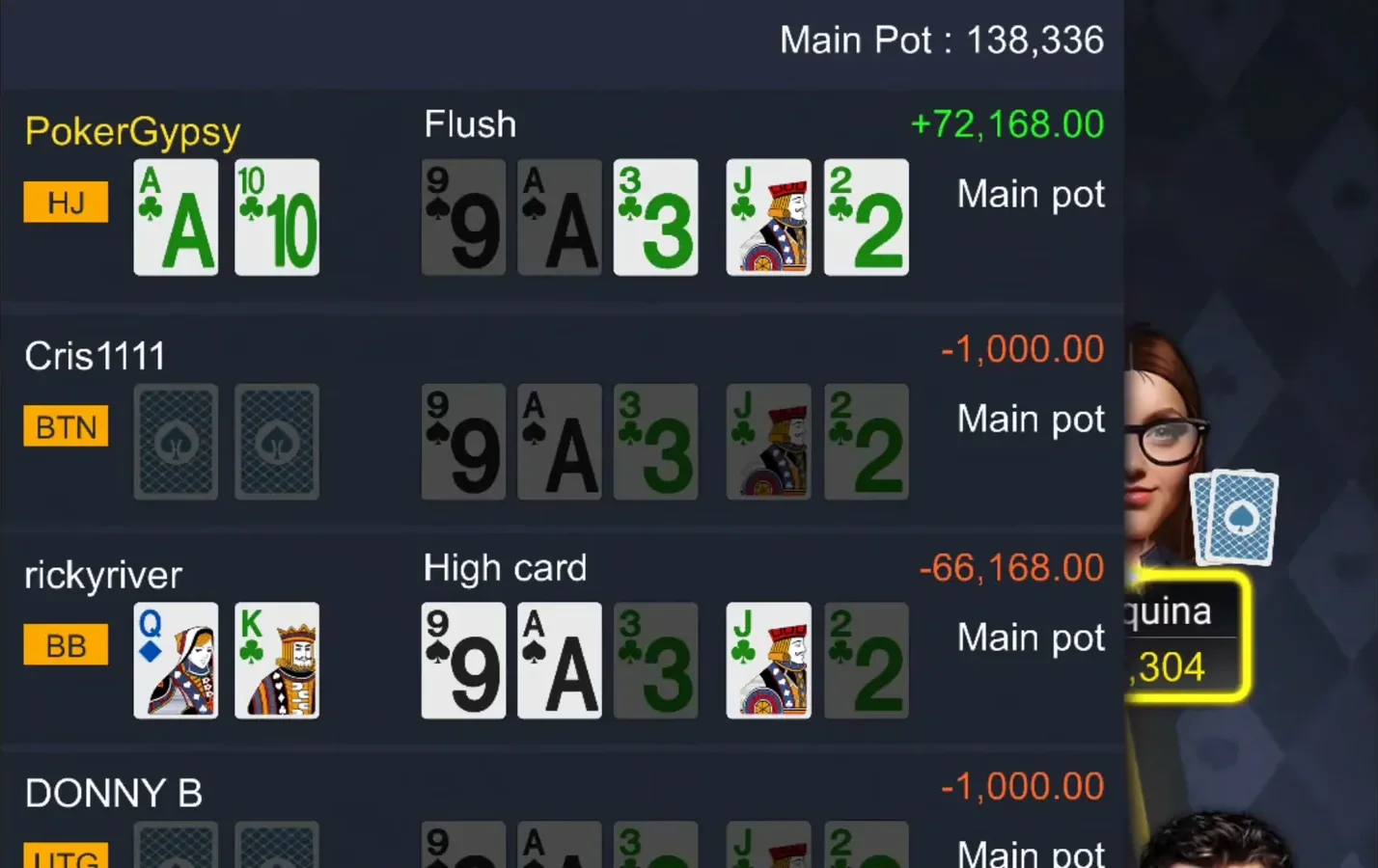
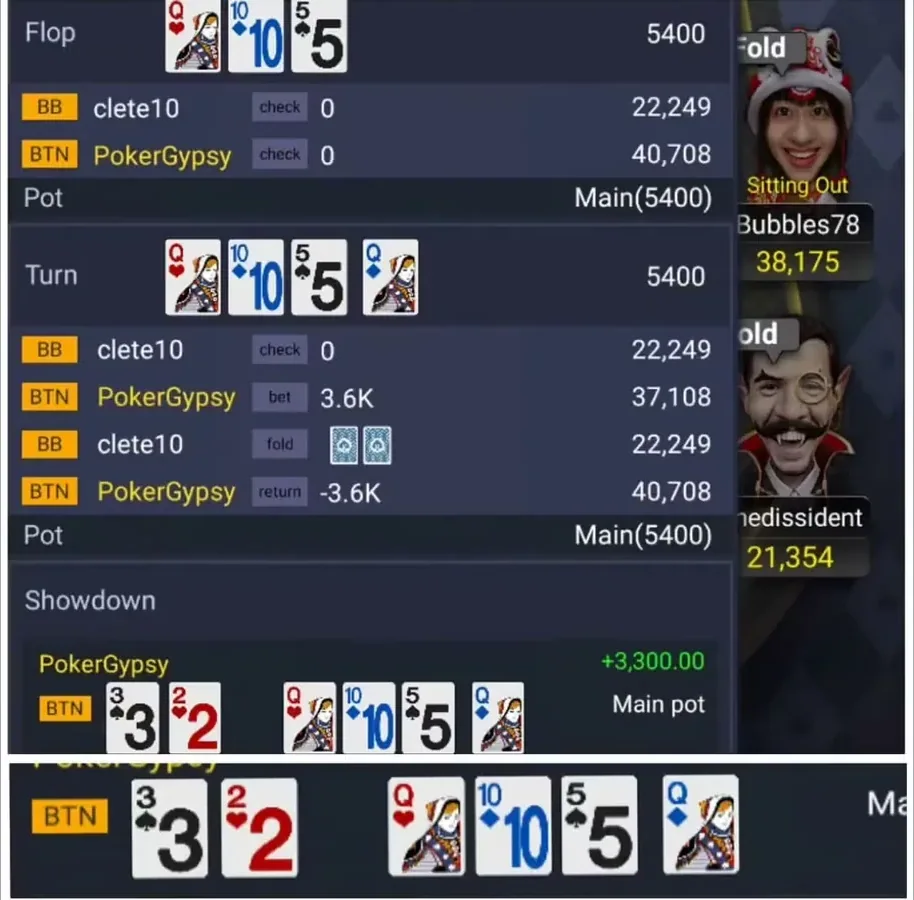
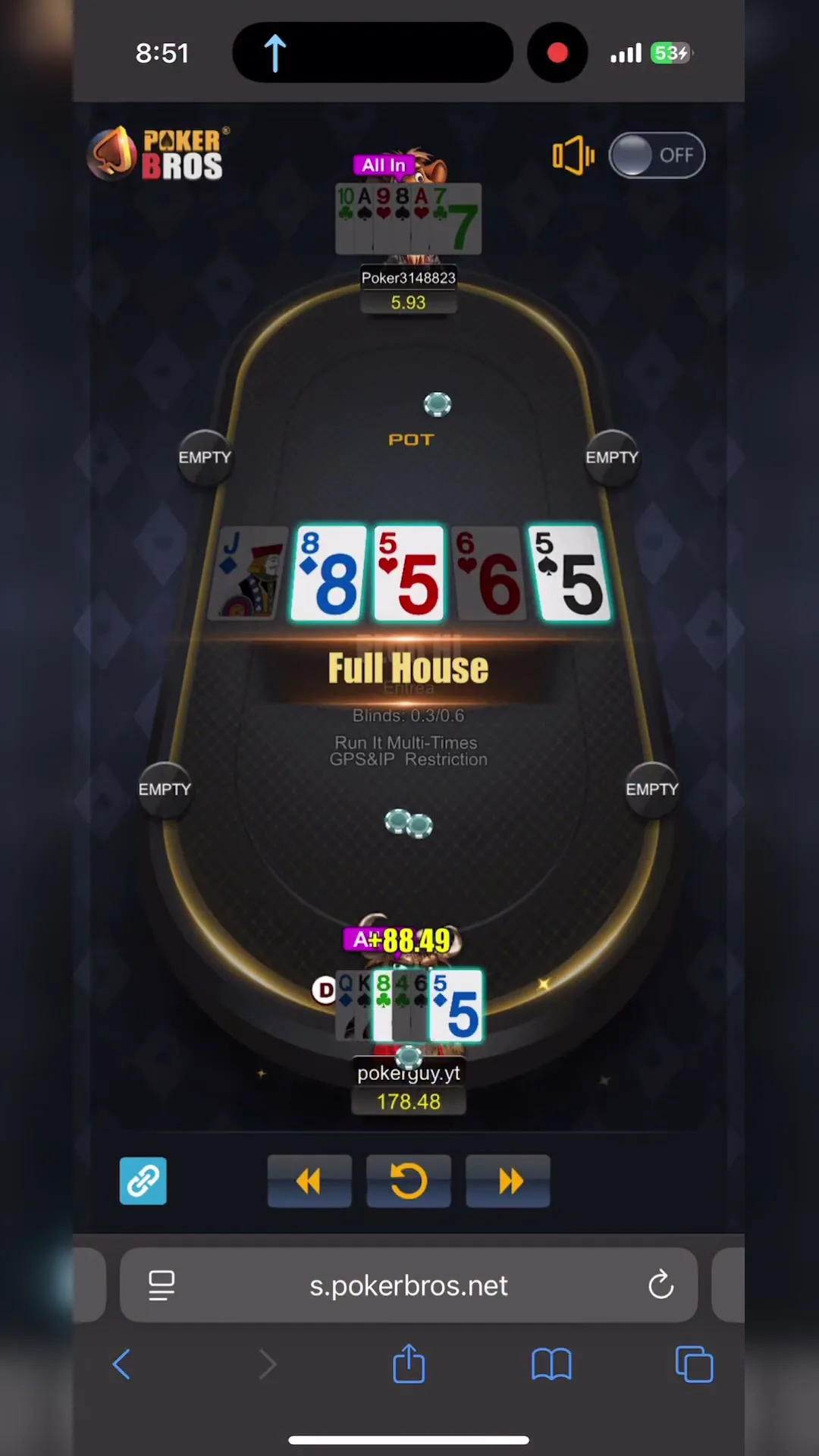
I've been on the losing end of enough bad beats to speak with feeling, not condescension. My own session data has stretches that felt cursed and turned out to be ordinary variance on inspection. The hand below is from one of those stretches:
The Real Threat Is Collusion, Not the Shuffle
This is the section the rest of the review builds toward: most "rigged" accusations in club apps describe collusion; the player just doesn't know what PokerBros collusion looks like.
The club model is structurally vulnerable to it. A club is a closed community. Everyone came in through the same handful of agents, many players share a Telegram group, and access is controlled by people whose income grows with traffic. Nobody verifies identity, so the same person can hold multiple accounts and friends can sit at the same table by arrangement. In a licensed room collusion happens too, but there are identity controls, security teams and account-linking detection. In a club, much of that doesn't exist.
Some PokerBros tables carry a "GPS & IP Restriction" that keeps players on the same network or at the same location apart. It stops the laziest teams. Posters on Reddit point out that a VPN or a GPS-spoofing app gets around it, so treat it as a speed bump rather than protection.
PokerBros does have a security function: the Game Integrity Bros team, reported by ProfessionalRakeback at around 14 people platform-wide. Fourteen people, however capable, against tens of thousands of players across thousands of clubs is a small team for the job. I don't know their internal effort, and I'm not accusing the platform of indifference. I'm giving you the ratio so you can price it into your expectations.
Four ways players cheat in club apps
- Card sharing. Two or more players reveal their hole cards to each other in a side chat while the hand is live.
- Multi-accounting. One person plays several seats at the same table under different accounts.
- Ghosting and RTA. A stronger player, or a solver, makes the decisions for someone else's seat in real time.
- Chip dumping. Losing pots on purpose to move a balance between accounts, to settle debts or to launder money. Regulated rooms run AML checks for exactly this; clubs don't.
How Card Sharing Works in Omaha
Once you see this mechanism, you'll never read "the app is rigged for action" the same way again.
Take a Pot-Limit Omaha table: four players, four hole cards each, sixteen cards held and thirty-six left in the deck. Suppose two of those players are teammates sharing their cards in a Telegram chat as the hand plays out. Each of them now sees eight cards instead of four, plus whatever the partner folded. That changes the hand in three observable ways.
First, the colluder commits with middle set and never seems to run into top set. A normal player with middle set on a dry board fears one thing: a higher set. The colluder knows whether the top-set card is still live, because his teammate folded it preflop and told him. He piles chips in with a confidence his hand shouldn't justify.
Second, he plays weak flush draws with strange aggression. In PLO a non-nut flush draw is usually a careful hand. If the colluder knows the nut-flush card is already folded, his "weak" draw is live against the remaining deck. He barrels into you with a hand a solver would call marginal, because his information isn't marginal.
Third, his math is better than it should be. The rule of 2 and 4 assumes you know nothing about the deck. A card-sharer knows how many of his outs are live. He folds when an amateur would call, calls when an amateur would fold, and over hundreds of hands his showdown win rate looks persistently wrong.
Now sit in the victim's chair. You lose three big pots in a session to the same player making plays that "don't make sense". You can't see the Telegram window, so the only explanation your brain reaches for is that the app deals action hands to keep people playing. A large share of the "rigged for action" complaints is this mechanism, misdiagnosed.
I didn't believe it when I first heard it at a table, from a player I respected. I thought it was paranoia. What changed my mind was going into my own data.
What I Found in My Own Tracker Data
Everything in this section comes from my own session review in DriveHUD, the tracking software I use to analyse my play after the fact. These are screenshots from my own video on the topic.
It started with a feeling. A regular at my PLO stakes was winning at showdown at a rate that didn't make sense to me: not in a lucky-run way, in a decisions-are-too-good way. Hands where I expected him to fear the obvious cooler, he committed. Hands where a draw should have made him careful, he pressed. My notes from that month contain the line: "this guy plays like he can see folded cards."
So I did the work. I exported my hand histories, pulled up every session we shared, and compared what trackers show well:
- how often we were seated together relative to random seating;
- whether our join and leave times matched;
- how he played against everyone else versus against one specific account at those tables.
And there it was: two accounts that were consistently at the same tables, whose big hands never seemed to collide, with folds and jams in spots that made sense only if they knew each other's cards.
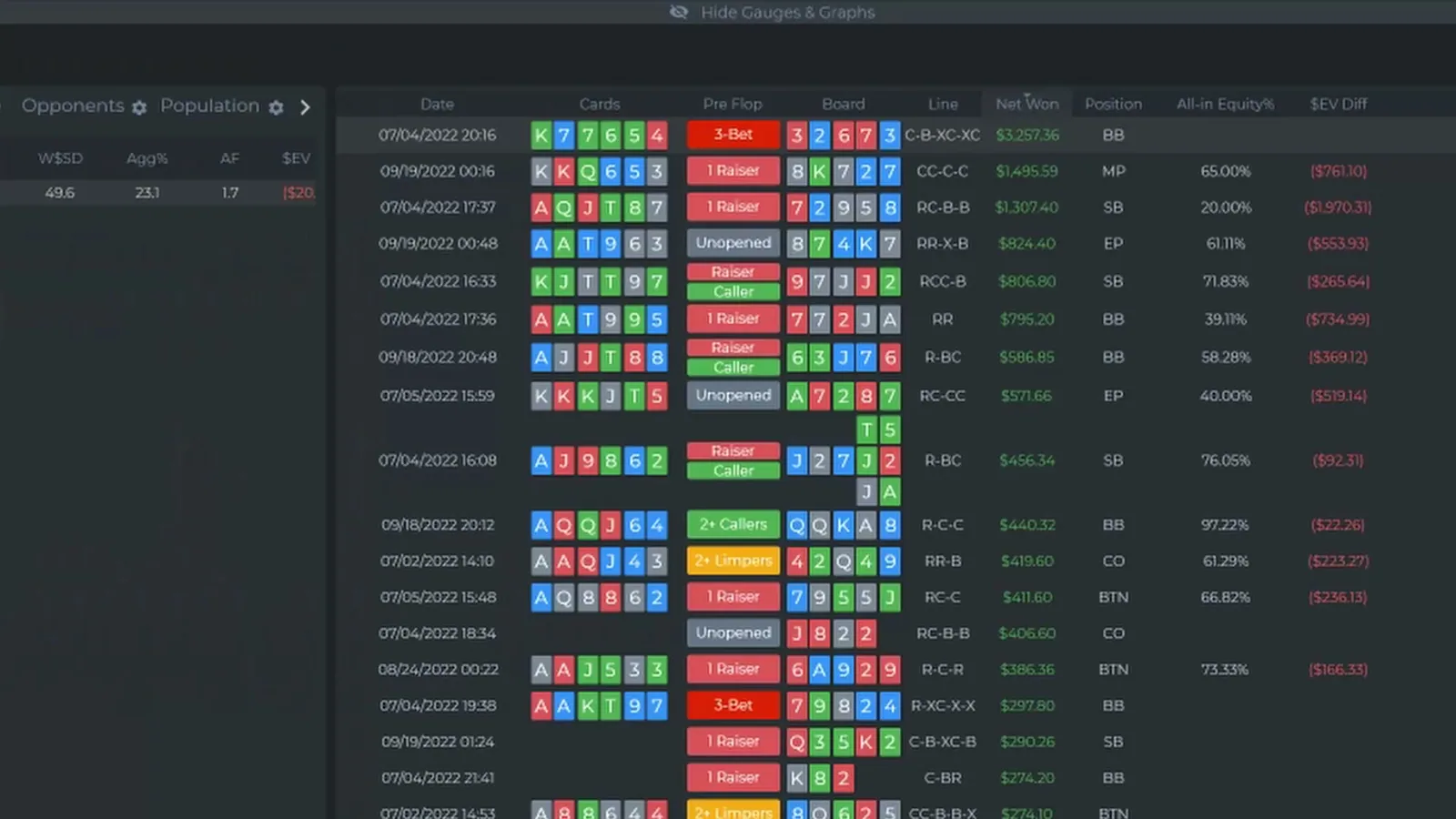
I'm going to be careful here. What I'm showing is a pattern in my own data: shared presence, matching timing, and lines consistent with shared information. I am not stating that specific, identifiable people committed fraud: the tracker shows players only as numeric IDs, and I name no one.
What I can tell you is what I concluded and what I did: this is the pattern I found, and it's why I stopped playing in that club. I raised it with people connected to the club, and the absence of any serious process for handling it told me where that club stood between its players and its rake.
That points at the incentive underneath all of this: colluders generate rake. An agent who investigates his own colluding players is investigating his own income, so don't expect that conversation to go well.
What can an ordinary player check without a tracker? More than you'd think:
Five red flags you can spot without a tracker
- The same two or three accounts always seem to be seated together, across multiple sessions.
- Those accounts never play a big pot against each other; big hands somehow always involve you.
- One of them plays a "soul-read" perfect game against you specifically.
- They join and leave tables within minutes of each other.
- When you raise a concern, the agent brushes it off in a hurry. The speed of the brush-off is itself data.
If you tick two or more of those boxes consistently, you don't need proof beyond reasonable doubt. You need a different club.
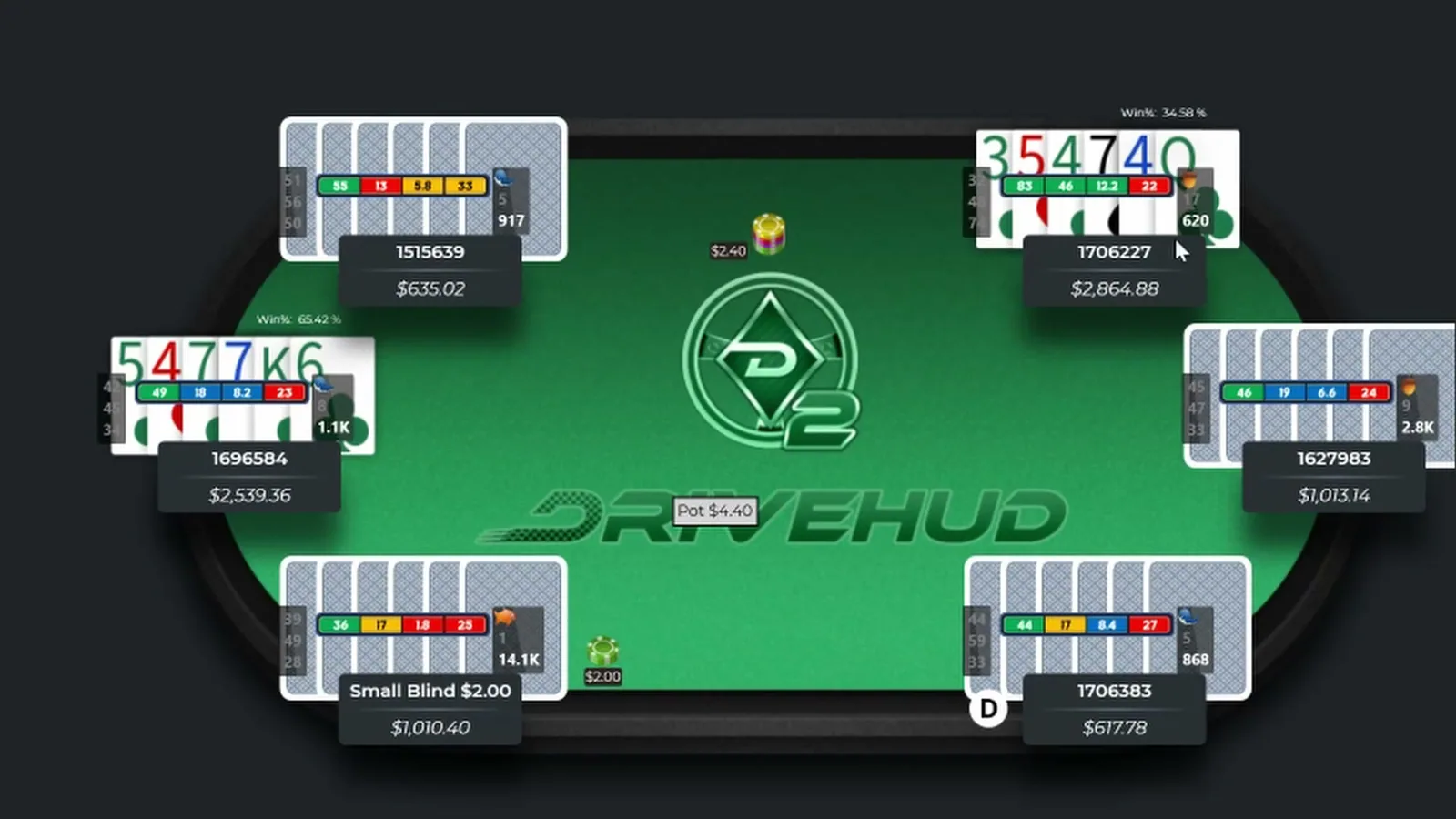
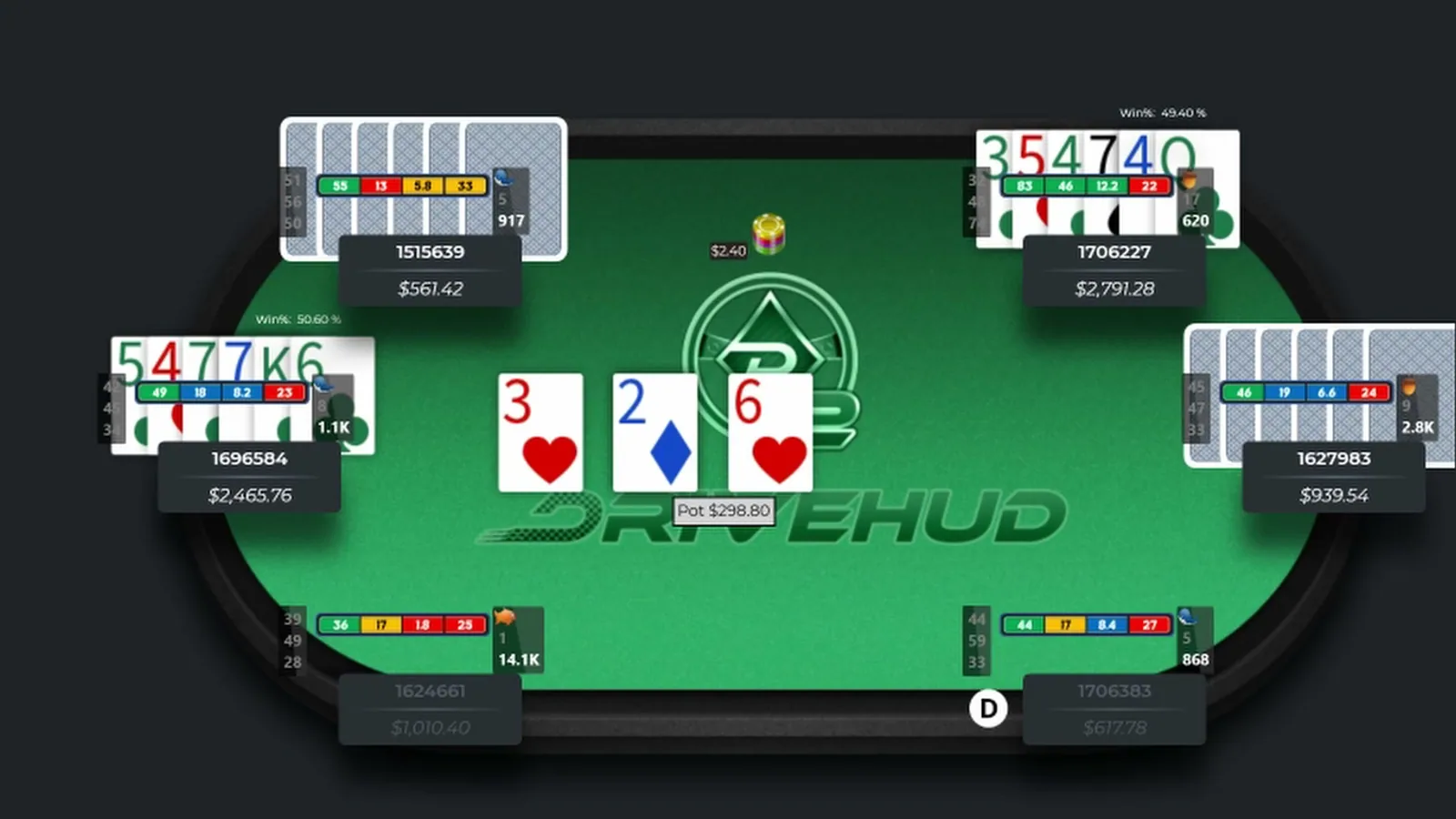
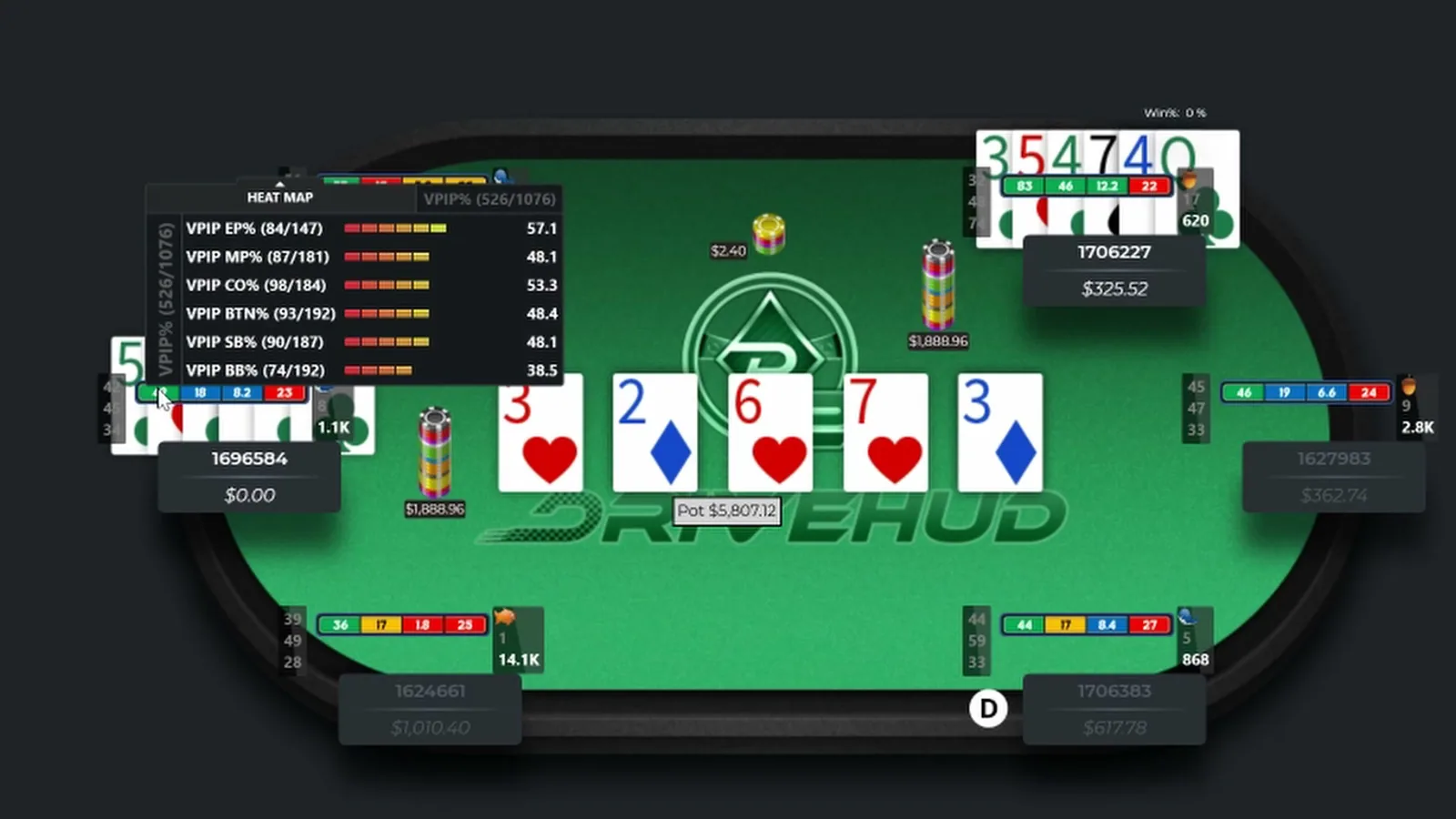
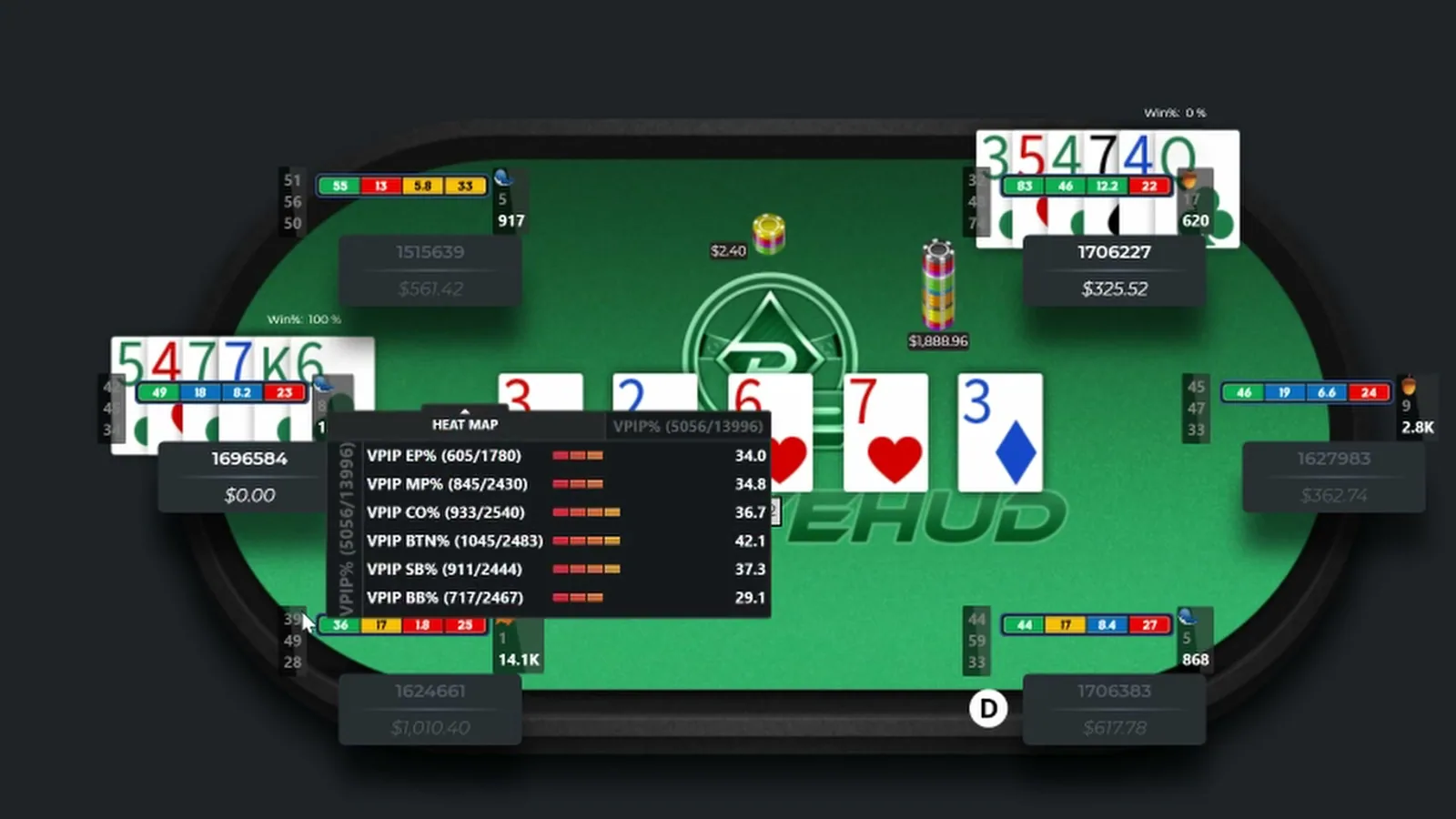
Screenshots from my own session review
These are my hands and my tracker database, not material borrowed from a forum. In the tracker frames players appear only as numeric IDs. Nicknames on the table screenshots elsewhere in this review are shown as the app displays them and say nothing about those players. I am describing a pattern that made me leave a club, not making a legal accusation against any individual.
PokerBros Scam Reports: What Actually Goes Wrong
Search "pokerbros scam" and you'll find hundreds of complaints: players down four and five figures, settlement money that never arrived, agents who vanished mid-conversation. Complaints are noise until you sort them. After years of reading these reports and playing inside this economy, nearly every scam story I know reduces to one of five scenarios.
1. The agent disappears with your balance. The simplest and the biggest. You build a bankroll, you request a withdrawal, and the person who took your deposits stops answering. There is no company to sue and no licence to complain to. Warning sign: an agent who resists keeping records, changes handles often, or pressures you to keep a larger balance "for convenience".
2. Slow-pay, the payout stretched over weeks. Technically not theft; at scale it works the same way. Your payout is always "coming at settlement", settlement keeps moving, and your money works in someone else's hands. Warning sign: the first small withdrawal already takes longer than promised.
3. Rake creep. The club raises the rake, adds a "service fee", or introduces charges that weren't in the original deal. Warning sign: any change announced casually in a Telegram chat instead of stated in writing up front.
4. Collusion the agent won't investigate. The scenario from my own data. The colluders generate rake, the agent's income depends on them, and the complaint dies. Warning sign: the agent has no process for integrity complaints at all.
5. The club closes and the chips are worth nothing. Every chip you hold is a claim on a private individual's goodwill. If the club folds, your claim is against someone who may no longer exist. Warning sign: a short history, no union affiliation, and an owner nobody outside the club chat has heard of.
The counterbalance matters too. On Reddit you'll find a player who won around $8,000 plus roughly $1,200 in freerolls and was paid immediately. Those stories are real. My conclusion after all of it: PokerBros is not a fraud by default. But the structure shifts all counterparty risk onto the player, and most players don't realise it until the risk has their name on it.
Thinklean's own terms make the last point in writing. Under Section 10 of the Terms and Conditions, the company's aggregate liability for anything arising from the service is capped at five hundred dollars. Read that clause before depositing.
| Pattern | How it starts | Early warning sign | What it costs |
|---|---|---|---|
| The agent disappears | A friendly agent, fast answers, growing balance | Replies slow down right after a big win | The whole club balance |
| Slow-pay | "It will go out at the next settlement" | The settlement day keeps moving | Weeks of your bankroll being held |
| Rake creep | Terms quoted verbally, never in writing | Rake or fees change without notice | A few percent of every pot, forever |
| Unpoliced collusion | You report a pattern, nothing happens | The colluders generate rake for the agent | Your edge, silently |
| The club closes | Traffic thins, then the club is gone | Tables empty, agent stops posting | Every chip on the account |
The terms say it out loud
Thinklean Limited's terms disclaim responsibility for money lost in club transactions, because the company's position is that it provides a platform and private individuals run the clubs. Legally that is coherent. Practically it means nobody is accountable for your balance except the person holding it.
What Real PokerBros Reviews Say
The ratings for this platform diverge wildly, and the divergence is the story. Trustpilot: 2.2 out of 5 from 11 reviews, 64% of them one-star. The US App Store: 4.5 out of 5 from about 6,900 ratings. PokerListings: 2.1, with a blacklist. Rakeback portals: 4.3 to 4.6.
Are people lying? Mostly not. They're rating different objects. App Store reviewers rate the app, and the software is good, so it gets good marks. Trustpilot and Reddit attract people who lost money in a club; they rate the money system, and it gets destroyed. Rakeback portals earn by sending players into clubs, so they rate the funnel that pays them. Both the one-star and the five-star reviews are sincere. They're about different things.
One more signal: the r/poker subreddit explicitly bans advertising "illegal app clubs". When the biggest poker forum on the internet walls these clubs off, that tells you how mainstream players view the model.
The cards below sum up what players say on those platforms, with a link to the material behind each theme.
What players actually say about PokerBros
These cards summarise recurring themes from public reviews, forum threads and app store listings, with a link to the material behind each one. They are not testimonials collected by this site: we publish no aggregate user score, and nothing sent through the form below appears here automatically.
The client is the part almost nobody argues about
Even reviews that tear the platform apart tend to concede the software. Store reviewers describe it as fast and stable, with multi-tabling and heads-up play that hold up; industry write-ups call the client modern and note that features keep arriving. On the US App Store the app carries 4.5 stars across roughly 6,900 ratings (September 2026), and that number is overwhelmingly about the app rather than the clubs.
Based onApp Store WorldPokerDeals Beasts of Poker
The games are genuinely soft, and that is the real draw
The most consistent practical praise: pools full of recreational players from the US and Latin America, which lets people beat stakes here that they could not beat in a mainstream room. The very first post in the long Two Plus Two thread opens with games "MUCH softer than we are used to seeing in other places", and coaching sites make the same point without romanticising it.
Action around the clock, with guarantees worth entering
Third-party estimates put the platform in the twenty to thirty thousand player range with roughly a thousand seated at peak, and reviewers point to daily tournaments with real guarantees plus bad-beat jackpots that run into six figures of chips. One App Store reviewer picks out exactly that: "so many games always running".
Based onApp Store WorldPokerDeals
Formats you will not find in most rooms
Beyond Hold’em the spread is unusually wide for a mobile client: four, five and six-card Omaha, Short Deck, Open Face Chinese and the fast Spin-It format. For Omaha players in particular this is one of the few places where the games run at all hours.
Based onProfessional Rakeback Beasts of Poker
It works where regulated poker simply is not available
For players in states and countries with no licensed option, this is the honest appeal. Sign-up takes a couple of minutes, needs an email and a username, and asks for no documents at all. Reviewers list that frictionlessness as an advantage while being clear about what it costs you later.
Based onMyPokerCoaching PokerListings
Plenty of people do get paid, and quickly
Worth holding against the horror stories. In the same Reddit thread where the platform is being called rigged, a player reports two years of play, wins of $8,000 and $1,200 out of freerolls, and being "paid immediately". Store defenders make the variance argument in similar terms: faster online dealing produces more visible bad beats than live play.
"It feels rigged" is the loudest complaint by a wide margin
Across every consumer platform the dominant theme is disbelief at showdown: one-outers, runner-runner boards and the sense that weak play is rewarded. Trustpilot sits at 2.2 out of 5 with 64% one-star reviews; App Store titles run from "App is totally rigged. Beware." to "Could not be more rigged". The company answers each one by citing its RNG certifications from iTech Labs, Gaming Labs and BMM.
Based onTrustpilot App Store JustUseApp
The money layer belongs to your agent, not to the app
The structural complaint, and the one that actually costs people money. Deposits and cashouts happen outside the client, between you and a private individual. The Two Plus Two moderators put it plainly: your money is controlled by a club or agent who "might sometimes be a single person operating out of their home", it is easy to become an agent and easier to disappear, and you should never deposit more than you are willing to lose entirely.
Based onTwo Plus Two Upswing Poker MyPokerCoaching
Slow-pay, partial pay, and cashouts that never arrive
Reports of agents stretching payouts for weeks or stopping altogether recur across affiliate reviews and forums, with sums described in the four and five figures. One account describes a $4,500 withdrawal arriving as 25 separate transactions. Because no cashier exists, the only escalation is reputational: posting on a forum and hoping the agent cares.
Based onPokerListings Professional Rakeback
The sharper accusation is collusion, not the shuffle
Experienced players keep separating the two. "The software isn’t rigged," one Reddit poster writes, "it’s just filled with collusion and multi accounting." A long post in the same thread walks through card sharing in Omaha in detail, and a coaching site lands on the same verdict: no evidence the deal is rigged, but bots and some collusion do happen in various clubs.
Based onr/poker r/poker MyPokerCoaching
Rake is set per club, and some clubs charge double
There is no platform-wide rake. The market norm is around 5% with a cap near three big blinds, but reviews report 10 to 12% on some games, roughly four times a regulated room, with the union taking up to another 10% of what the club collects. Players also complain about rake being taken inside tournaments in ways they did not expect.
No verification anywhere means no recourse afterwards
The same missing KYC that makes sign-up painless means nobody in the chain is verified: not you, not the agent, not the club owner. The terms disclaim liability for money lost in club transactions, and the official fair play page routes complaints to "your respective Club host or Your Agent" — the very person a payment dispute would be about. Store reviewers separately note the absence of any self-exclusion tool.
Based onPokerBros fair play policy Professional Rakeback App Store
What the Official Fair Play Policy Leaves Out
Plenty of reviews quote the app store page. Few read the platform's own Safe and Fair Play policy and compare it with what players worry about. I did.
First, what the policy covers. It prohibits chat abuse, third-party software and bots, buying gems or diamonds from unauthorised resellers ("Don't be fooled — it's a scam," the page warns), selling or sharing accounts, phishing, spam and impersonation of staff. On enforcement, it describes a mix of automated and manual review, with moderators focusing on leaderboards, tournament participants and community reports. Taken at face value, that is a real policy with real subjects.
Now the omissions. On the platform's official page about safety, there is:
- nothing about the safety of a player's money,
- nothing about collusion between players,
- nothing about RNG certification,
- nothing about identity verification,
- and nothing about compensation for losses.
The topics that dominate every player complaint forum, namely funds, collusion and identity, do not appear on the only page the platform maintains about safety.
One detail deserves its own paragraph. The policy's stated channel for reporting misconduct is "your respective Club host or Your Agent." In most of the failure modes in this review, that is the person causing the problem. If your agent won't pay you, the official guidance is to complain to your agent.
| What the policy covers | What it does not cover |
|---|---|
| Abusive language and harassment in chat | The safety of any money you deposit |
| Bots, hacks and third-party software | Collusion between players at a table |
| Buying diamonds from resellers | RNG certification or fairness testing |
| Selling or sharing game accounts | Identity verification of players or agents |
| Phishing, refund abuse, bug exploitation | Compensation when a club fails to pay |
PokerBros Rake, Rakeback and What the Game Really Costs
Nobody joins a poker club to read about rake. But rake is where club poker differs most from everything you've played before, and where the choice of club costs you more than the choice of strategy.
The rake. Reported typical figures: around 5% of each pot, capped at roughly 3 big blinds, with no-flop-no-drop (no rake if the hand ends preflop). At NL200 and above the cap reportedly drops to about 2BB. Those numbers would be unremarkable in a regulated room.
The catch is that the club owner sets the PokerBros rake, and the platform doesn't standardise it. Rake of 10–12% reportedly shows up on some games, up to four times a normal online room, and players only discover it by reading the club rules closely. The union then takes its cut on top, reported at up to 10% of the rake the club collects.
The rakeback. Agents commonly offer 15–50% PokerBros rakeback depending on volume and the deal. It is not a gift; it is a partial refund of rake you already paid, and club fees and withdrawal charges can eat into it. Players also complain about rake taken inside tournaments in ways they didn't expect, from the buy-in and then per hand. Read the club's rules; don't assume them.
A concrete example: a NL50 regular playing 800 hands a day, twenty days a month. At 5% rake with a sensible cap, his monthly rake might land around a few hundred dollars. The same player in a 10% club with a higher cap pays roughly double: a four-figure annual difference, paid not for better opponents or software but for signing up with the wrong club. Choosing a club is a financial decision before it's a poker decision.
My standing advice: before you deposit, ask your agent for the exact rake structure, rakeback terms, fees and settlement day in writing, and keep the chat log. An agent who won't put terms in writing is telling you something for free.
| What is charged | Reported figure | Who sets it |
|---|---|---|
| Rake, NL10 to NL100 | About 5% of the pot, capped near 3BB | The club owner |
| Rake, NL200 and above | About 5%, cap reportedly drops to about 2BB | The club owner |
| Rake in the worst clubs | 10 to 12% on some games | The club owner |
| No flop, no drop | No rake if the hand ends preflop | The club owner |
| Union cut, on top of the above | Up to 10% of the rake the club collects | The union |
| Rakeback returned to you | 15 to 50%, by volume and deal | Your agent |
Ask your agent these five things before you deposit
- What exactly is the rake and the cap, on each game you intend to play?
- What is the rakeback percentage, and on what is it calculated?
- Which day is settlement, and what is the cutoff for a request to make that cycle?
- What fee, if any, do you charge on a deposit and on a cashout?
- Has the rake in this club changed in the last twelve months?
Get the answers in writing, in the chat, and keep the log. It is the only record that will exist.
PokerBros Deposits and Withdrawals: How Getting Paid Works
"Withdrawal times depend on the agent" is true and not very useful. The mechanics are more useful: once you understand the settlement cycle, "paid in 10 minutes" versus "paid in 6 days" stops being a mystery.
The settlement cycle. Most clubs settle with players in cycles, often weekly on a fixed day. A withdrawal request doesn't start a payment; it queues your payout for the next cycle. Request the day after settlement and you may wait nearly a week. Request the day before and you may be paid the same day.
Two players telling opposite stories on Reddit ("instant payout!" / "six days, scam!") may be describing the same agent at different points in the same week. The variable isn't only trustworthiness; it's the calendar. Learn your club's settlement day before your first deposit.
The rails. Crypto is the most common method internationally. Inside the US, agents typically take Zelle, Venmo or Cash App; internationally, Skrill and Neteller appear. The individual agent sets fees and timings. There is no common standard, no published fee table and no cap.
The irreversibility. No documents means no payment protection. A Zelle transfer or a crypto send is final the moment it leaves your account: no chargeback, no fraud department, no "dispute this transaction". The pipeline that credited your chips in ten minutes is the same one that makes your money unrecoverable. That is not a bug in the system; it is the system.
Two habits from my own practice. First, the small-first-withdrawal test: before you build a bankroll with a new agent, deposit a small amount, play a bit, and withdraw it. You're not testing the poker; you're testing the counterparty. An agent who pays $80 promptly in week one is worth more than any review you'll read. Second, keep only a playing bankroll in the club. Never your full roll, never your savings.
What the advertised timings actually are
There is no official PokerBros withdrawal time, because there is no cashier. Every figure below is an individual agent's promise, which is why they contradict each other:
| Who says it | Deposit credited | Cashout paid |
|---|---|---|
| AppPokerDeals / PokerProDeals | "instantly" | "within two hours" for a daytime request |
| DonkHunter | not stated | "within the max time of 24 hours of the request" |
| ItalyPokerDeals | "usually within a few hours" | "once per week, when settlement is made" |
| GipsyTeam (own clubs) | not stated | 24 hours |
| PokerListings (rival affiliate) | not stated | "may take a very long time"; slow-pay and non-payment reported |
The same platform is described as paying in two hours and as paying once a week. Both are true, because they describe different agents. A well-capitalised agent fronts the money from his own pocket and settles with the club later, so you get paid in hours. A thinly capitalised one can only pay you after the club settles with him, which happens weekly, commonly on Mondays. You are not choosing a payout speed; you are choosing whose balance sheet you stand on.
| Method | Typical speed | Fee | Reversible | Notes |
|---|---|---|---|---|
| Bitcoin, USDT | Same day once settled | Agent's choice | No | The most common rail by far |
| Zelle, Venmo, Cash App | Same day once settled | Agent's choice | Effectively no | US players; personal accounts |
| Skrill, Neteller | One to two days | Agent's choice | Limited | More common outside the US |
| Bank transfer | Several days | Agent's choice | Sometimes | Rare, and leaves the clearest trail |
The small-first-withdrawal test
Before you move a real bankroll in, deposit a modest amount, play a little, and cash out most of it. You are testing whether the agent answers, how long a settlement takes, and what gets deducted. It is the cheapest due diligence available.
Is PokerBros Legal in the US and Canada?
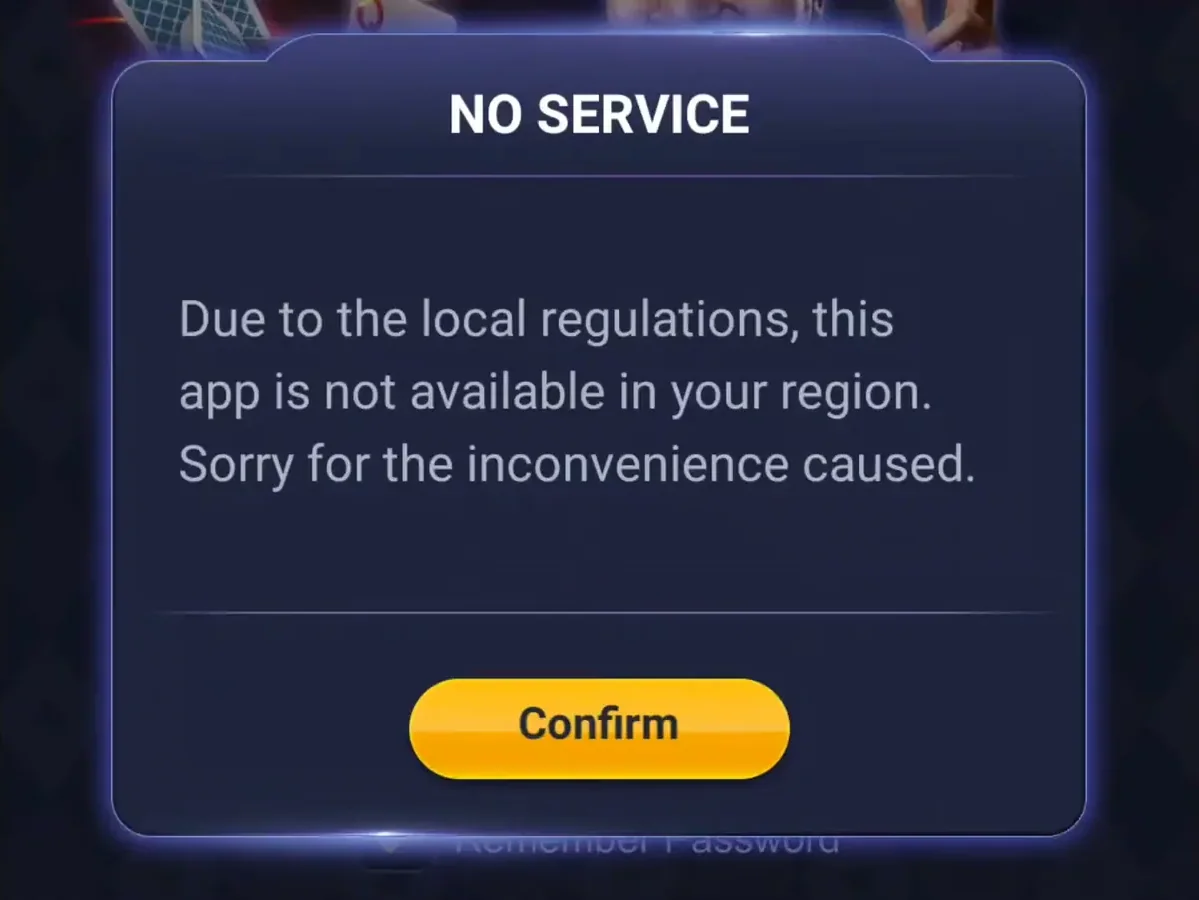
Formally, the app deals play chips. That places it in the social-gaming category, which is why it's downloadable in states where real-money online poker is prohibited: on paper, the platform never runs a real-money game.
The real-money layer, where your $1,000 moves, sits between you and your agent, outside the platform: your Zelle transfer, your crypto send, your settlement. That layer is the grey zone, and by its own terms the platform is neither involved in it nor liable for it.
At federal level, the UIGEA of 2006 targets businesses that accept payments for unlawful internet gambling, not individual players, and the Wire Act concerns interstate wagering businesses. Neither was written with social chip apps in mind. Whether your participation in the real-money layer is legal depends on your state or province, and that is a question for a lawyer, not a reviewer.
One data point: Minnesota was cut off from the platform on September 4, 2020 (per ProfessionalRakeback). The platform adjusts its availability when legal pressure appears, which tells you where it believes the line sits.
Canada differs in one province. Ontario has run a regulated online gaming market since April 2022 under the AGCO and iGaming Ontario, with licensed poker such as PokerStars Ontario. If you're in Ontario, you have a legal, licensed alternative that most Americans don't. In the rest of Canada and in unregulated US states, club apps sit in the same grey zone.
Taxes. Gambling winnings are taxable regardless of where they were won. In the US they are income; certain winnings trigger Form W-2G reporting, and even where no form is issued, the income is reportable to the IRS. In Canada, the CRA treats casual winnings differently from those of people who play as a business. The details are jurisdiction-specific and belong with a tax professional, but every player I know wishes someone had mentioned this earlier.
This is not legal or tax advice
I'm not a lawyer, and this section is not legal or tax advice. Laws differ by state and province and they change. If real money is involved in your decisions, talk to a professional where you live.
| Where you are | What that means in practice |
|---|---|
| Regulated US poker state (NJ, PA, MI, NV, DE) | You have licensed alternatives with real recourse |
| Unregulated US state | Club apps are the grey-market option, with the risks on this page |
| Minnesota | Blocked by the platform since September 2020 |
| Ontario | A regulated market exists under AGCO and iGaming Ontario |
| Rest of Canada | Mixed, and worth checking provincially before you deposit |
How to Vet a Club and an Agent: A 12-Point Checklist
This is the tool I wish someone had handed me before my first deposit. "Find a reputable club" is common advice; here is how to do it.
A mindset first: you're not choosing a poker room, you're choosing a counterparty. Nobody vetted your agent. Nobody audited the club. The vetting a regulated room does for you is, here, your job. Twelve checks, each phrased as what to ask and which answer should worry you:
- How long has the club operated, and which union does it belong to? Worry if: the club is months old with no union and an owner nobody can vouch for.
- Does the agent have a public history outside Telegram? Worry if: their whole presence is one Telegram handle, months old.
- Will the agent state rake, rakeback, fees and settlement day in writing? Worry if: anything is "we'll sort it later".
- How fast does a small test withdrawal clear? Worry if: the first small payout already slips past the promised settlement.
- Does the club have a real process for collusion complaints? Worry if: the agent has never heard the question before.
- Does the agent allow partial settlements? Worry if: your balance must always stay "in play".
- How many players are seated during your playing hours? Worry if: the lobby is empty exactly when you'd play.
- Has the rake gone up in the past year? Worry if: yes, and long-time members are leaving.
- Can you find two independent players from that club, not referred by the agent? Worry if: everyone you meet comes through him.
- Does the agent hold chips on your behalf, or do you hold the balance? Worry if: you can't get a straight answer. In practice it's always the former, but an agent who lies about it will lie about anything.
- What happens to your balance if the club closes? Worry if: the answer is a shrug.
- What does a forum search on that agent's name turn up? Worry if: the first page of results is unresolved complaints.
And the short version, the red flags that should end the conversation on the spot:
Red flags that should end the conversation
Pressure to deposit more than you planned · refusal to put terms in writing · urgency ("this club closes tonight") · payment only in crypto from a brand-new wallet · any suggestion you move money to "a better club" mid-dispute.
One principle from Two Plus Two worth repeating: never deposit more than you're willing to lose entirely. In this system that isn't pessimism; it's the house odds.
What to Do If You Have Already Been Scammed
If you're reading this section, I'm sorry: this is the search people run at the worst moment of their club-app experience. In this system there are no legal guarantees, and anyone promising guaranteed recovery is running a second scam on top of the first. But "no guarantees" is not "nothing to do". There is a sequence, and the first two steps matter most.
Step 1: preserve evidence, immediately. Balance screenshots with timestamps, the complete chat history with your agent (export it; don't rely on the app staying available), transfer receipts, the club's name and ID, your agent's handles and payment addresses. It costs an evening and it's the only asset you'll have in every later step.
Step 2: escalate up the chain, agent → club owner → union. It occasionally works. Some unions police their member clubs because a club that burns players hurts the union's reputation with other agents. Frame it factually and attach your evidence.
Step 3: contact platform support ([email protected]). Do it for the record. By its own published policy, the platform does not intervene in club finances, so expect a polite non-answer and don't mistake it for progress.
Step 4: go public, factually. Two Plus Two and the relevant communities. For an agent, reputational loss is the only real sanction in this economy: there is no licence to revoke and no regulator to call. Stick to facts and evidence; accusations you can't prove expose you legally.
Step 5: assess the payment trail. A card chargeback is sometimes possible, in a narrow window, if you paid by card through a mechanism that permits it. Crypto, Zelle, Venmo and Cash App essentially never come back.
In this system, your only real protection works before the transfer, not after. That's why the checklist in the previous section exists. And if money stress is part of what brought you here, the help resources at the end of this review matter more than any of it.
Preserve the evidence
Screenshot the balance, export the full chat history with the agent, save transfer receipts, and record the club and agent IDs before anything is deleted.
Escalate up the chain
Agent, then club owner, then union. In some unions reputation has real commercial value and this occasionally produces a payment.
Contact platform support
Write to [email protected]. By its own published policy the platform does not intervene in club finances.
Go public
Post the details on Two Plus Two and in the relevant communities. For an agent, losing reputation is the only sanction that exists.
Check the payment trail
A card chargeback is occasionally possible. Crypto and peer-to-peer transfers essentially never are.
What almost never works
Crypto recovery services, threats in the club chat, complaints to the app stores, and demands to the platform. None of these has a mechanism behind it. Your leverage exists before you send money, not after.
Games, Stakes and How Soft the Field Really Is
With the risks priced in, here is why people keep showing up anyway. This part of the review is positive.
Formats. PokerBros runs the full modern menu: no-limit hold'em, Pot-Limit Omaha in 4-, 5- and 6-card versions (PLO is the lifeblood of club poker), Short Deck, Open Face Chinese, multi-table tournaments, sit-and-gos, and the fast jackpot-style Spin-It format with random multipliers.
| Format | What it is | Notes |
|---|---|---|
| NLHE | No-limit Texas hold'em | Cash tables and tournaments in most clubs |
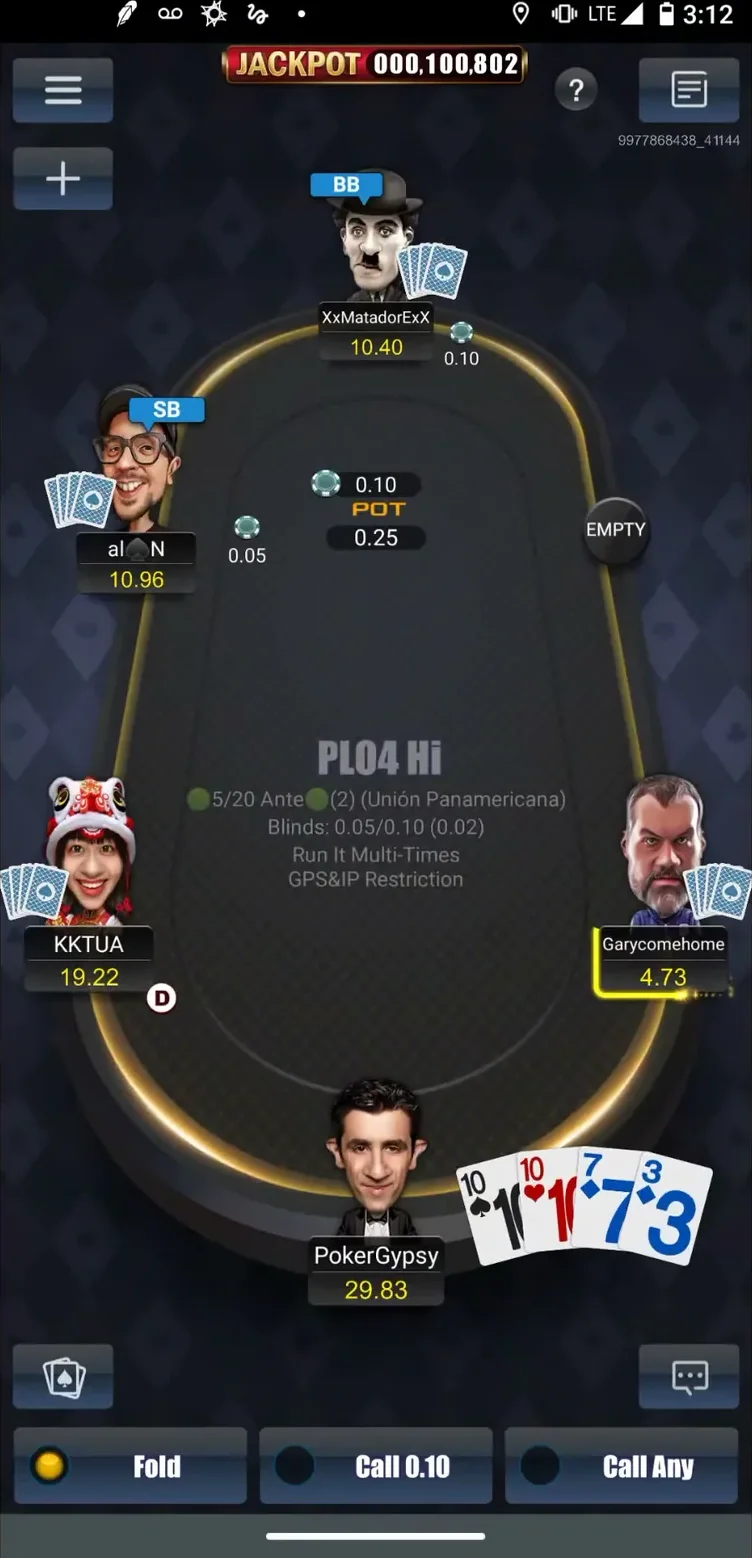
| PLO4 / PLO5 / PLO6 | Pot-limit Omaha with 4, 5 or 6 hole cards | The busiest games in many clubs; our PLO4 screenshot runs at 0.05/0.10 |
| Short Deck (6+) | Hold'em with the 2s to 5s removed | Smaller pool, runs in bigger unions |
| OFC | Open Face Chinese, scored by points | Niche, but hard to find elsewhere |
| MTT / SNG | Multi-table tournaments and sit-and-gos | Freerolls and guarantees set by the club or union |
| Spin-It | Three-handed jackpot sit-and-go | Prize multiplier drawn at random before the start |
Traffic. Third-party estimates put the platform at 20–30 thousand players, with roughly a thousand online at peak. Treat those as estimates, not platform data. What matters more: platform traffic and your club's traffic are different numbers. You only see the tables of your own club and union. A big platform means nothing if your club's lobby is empty at your hours, which is why point 7 of the checklist asks about seated players during your playing hours.
Field softness. This is the strongest argument in favour. Recreational players who learned the game on their phones are the club apps' core audience, and the standard of play reflects it. If you've been ground down at tough regulated tables, club PLO can feel like a different sport.
The caveat from someone who loves these games: a soft field and weak security are two sides of the same coin. The absence of verification that lets a dentist from Ohio punt off three buy-ins also lets two teammates share cards. Nobody vets the bad players, and nobody vets the colluders. You get both, together.
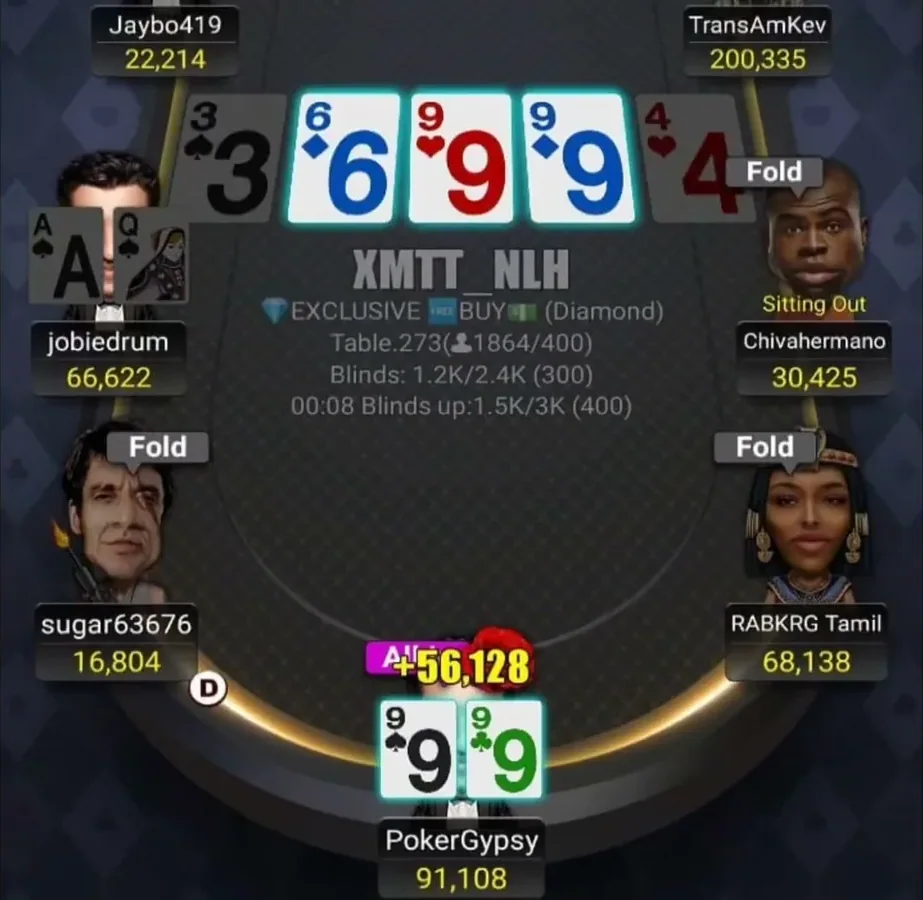
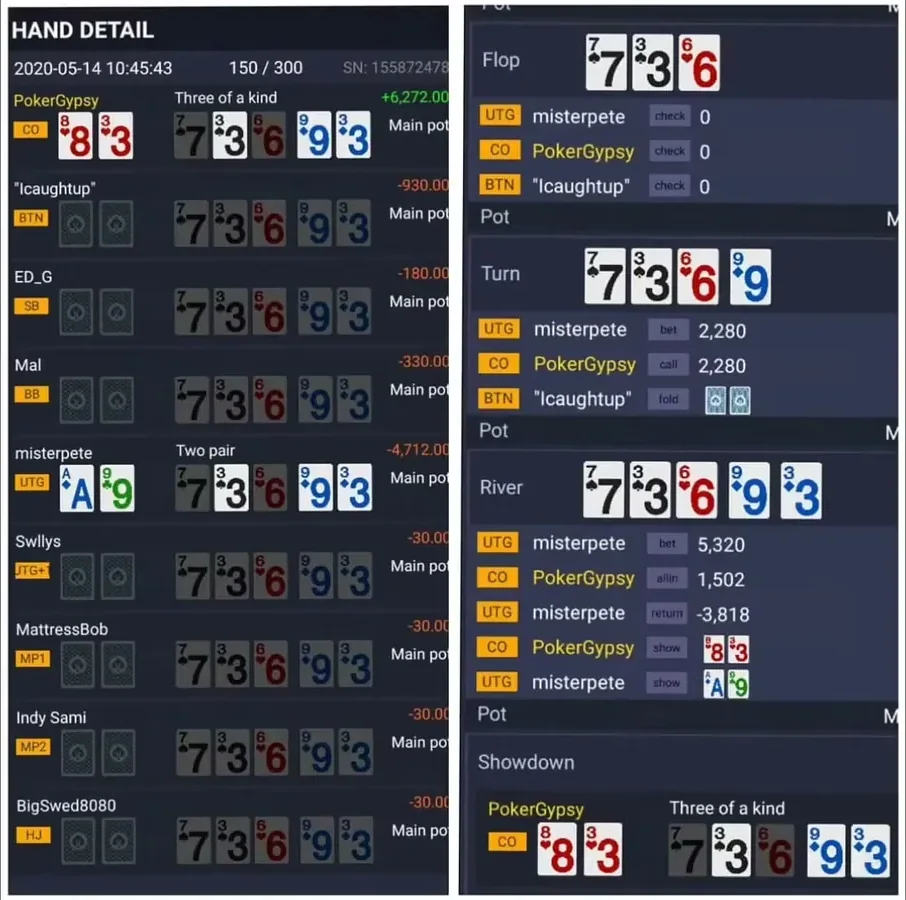
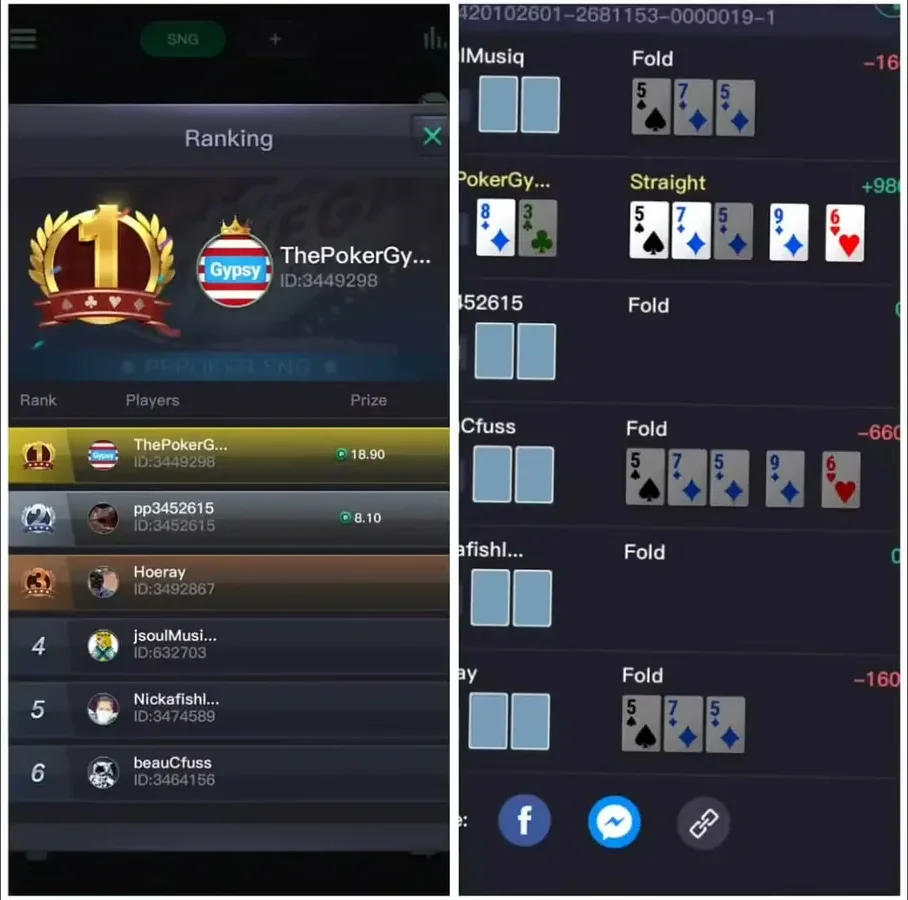
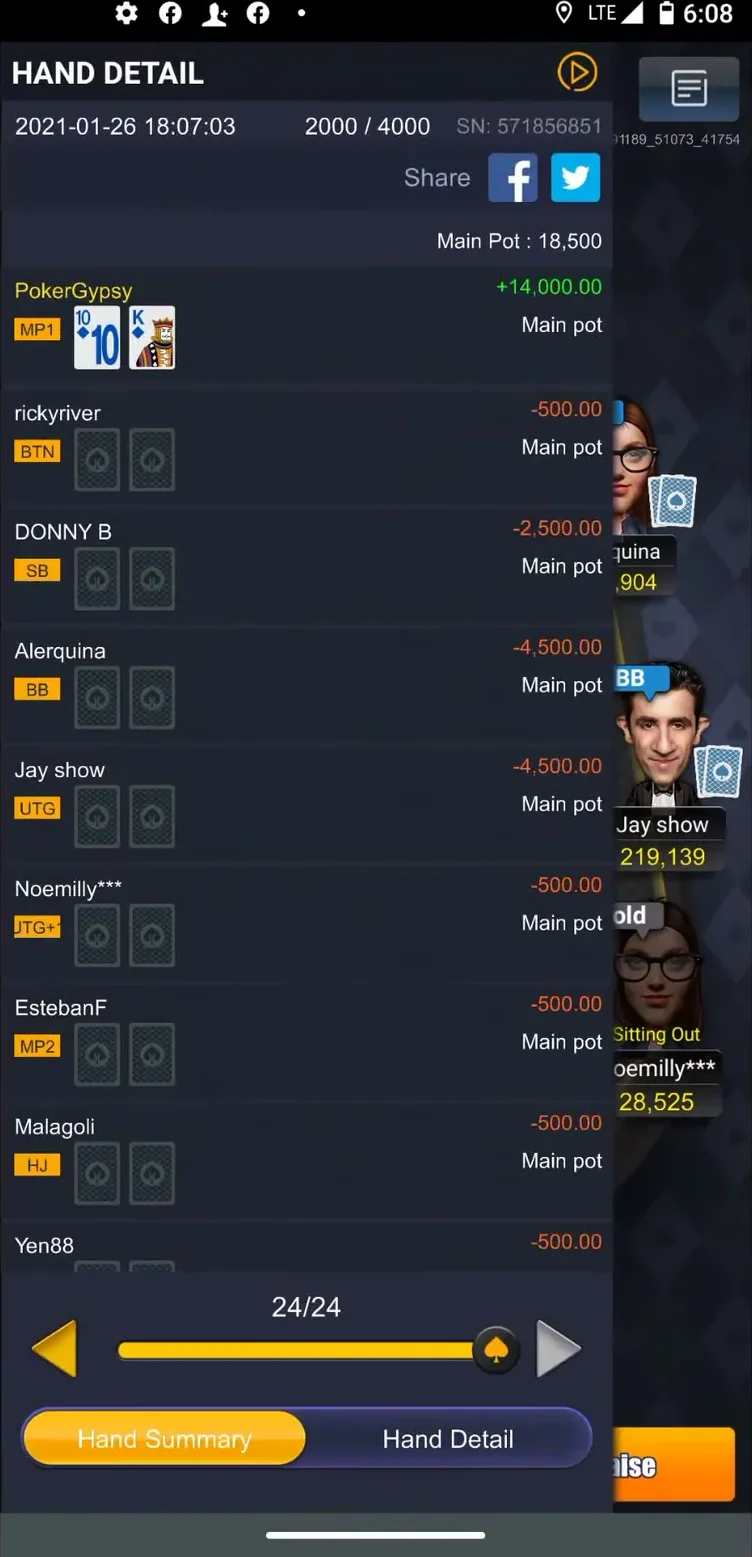
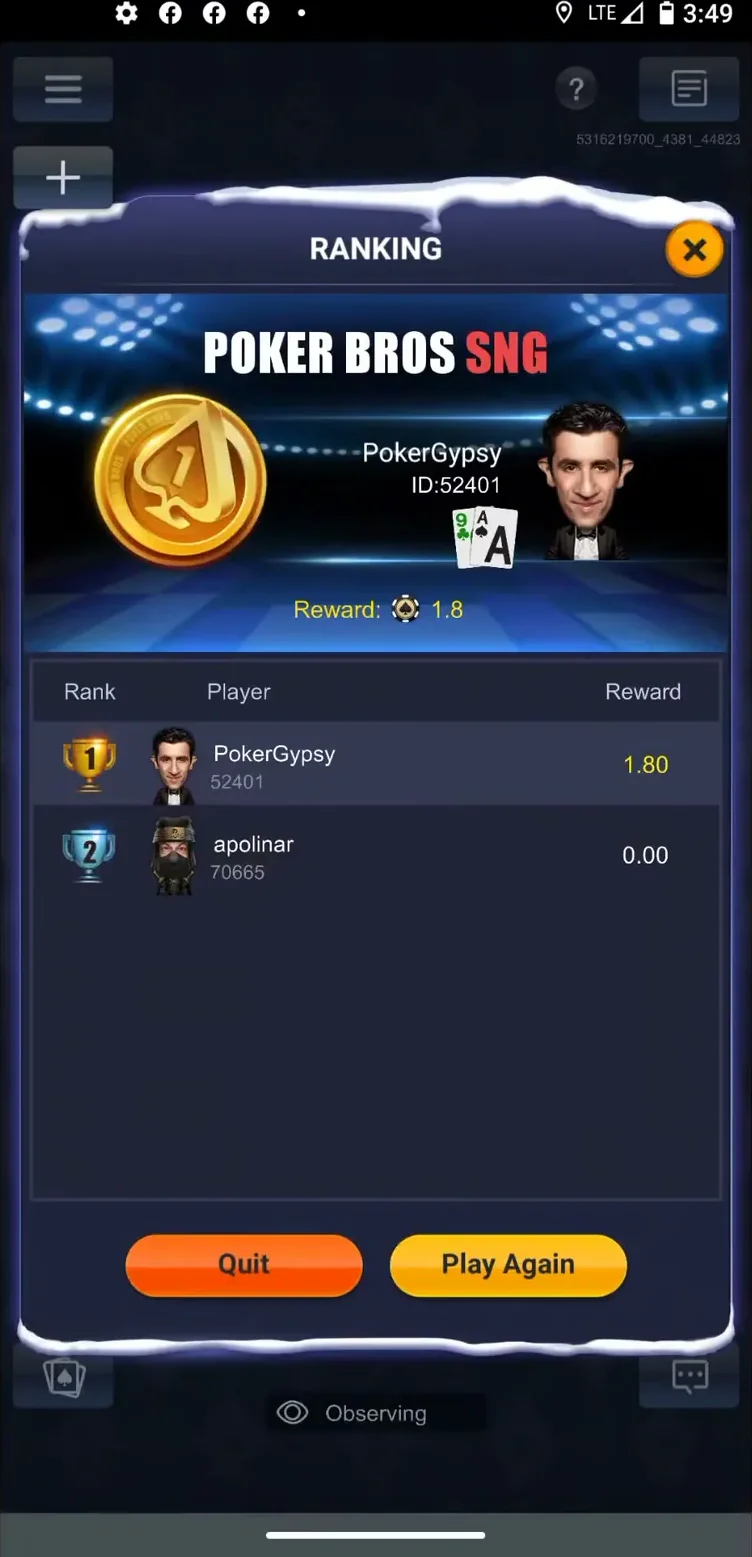
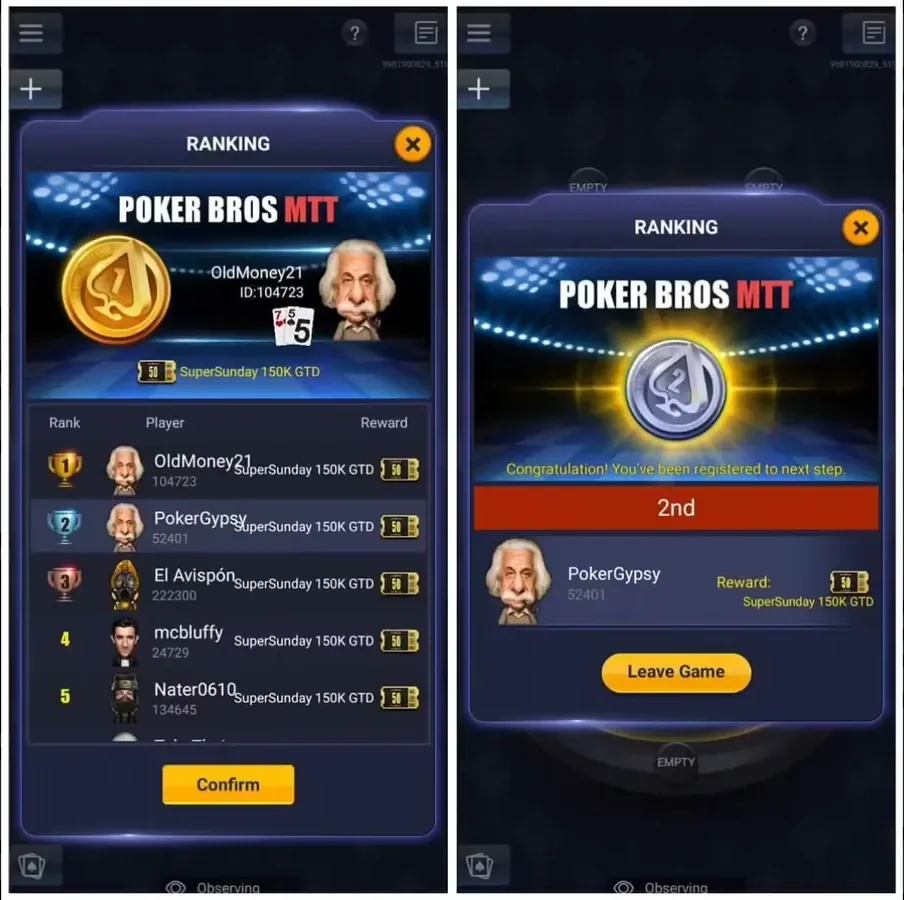
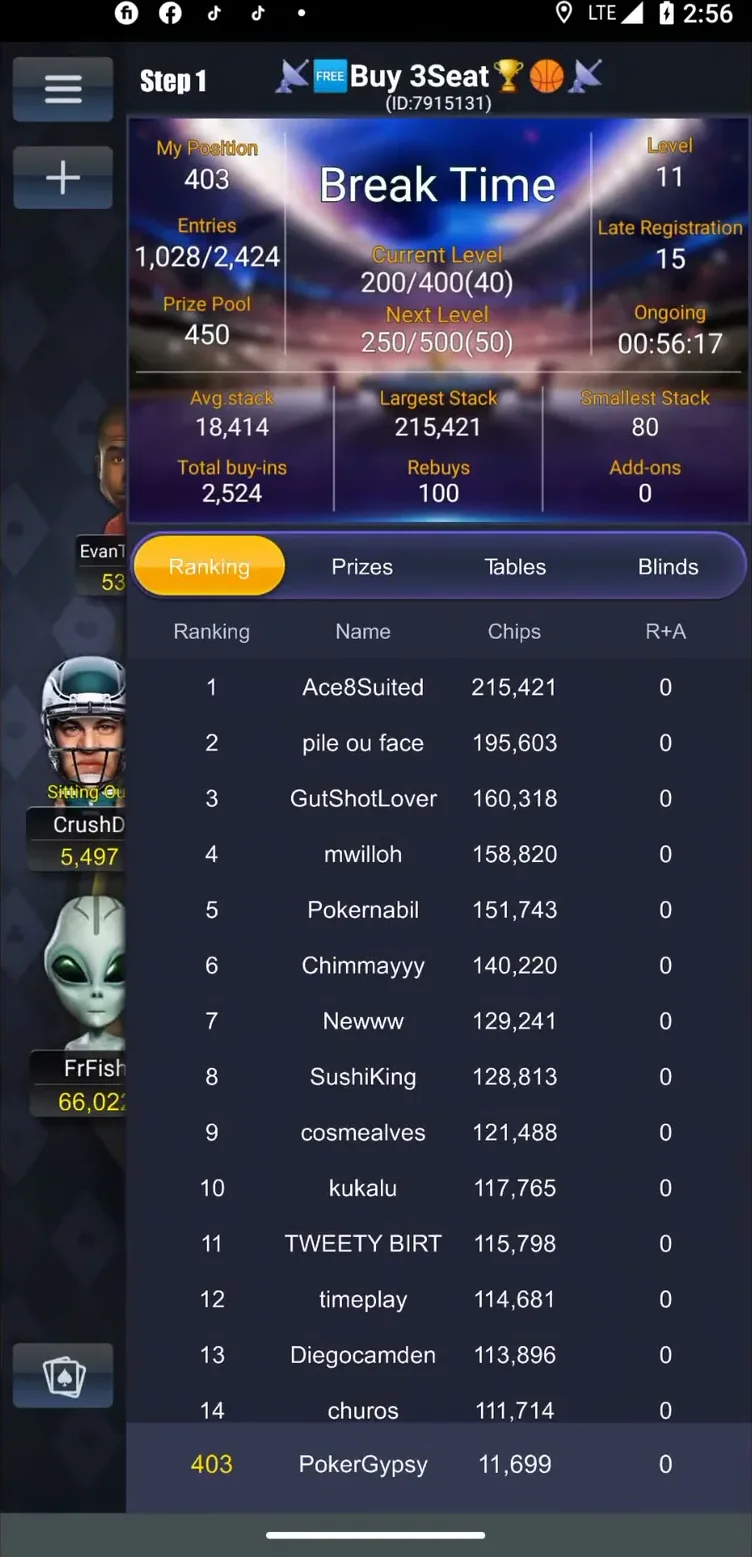
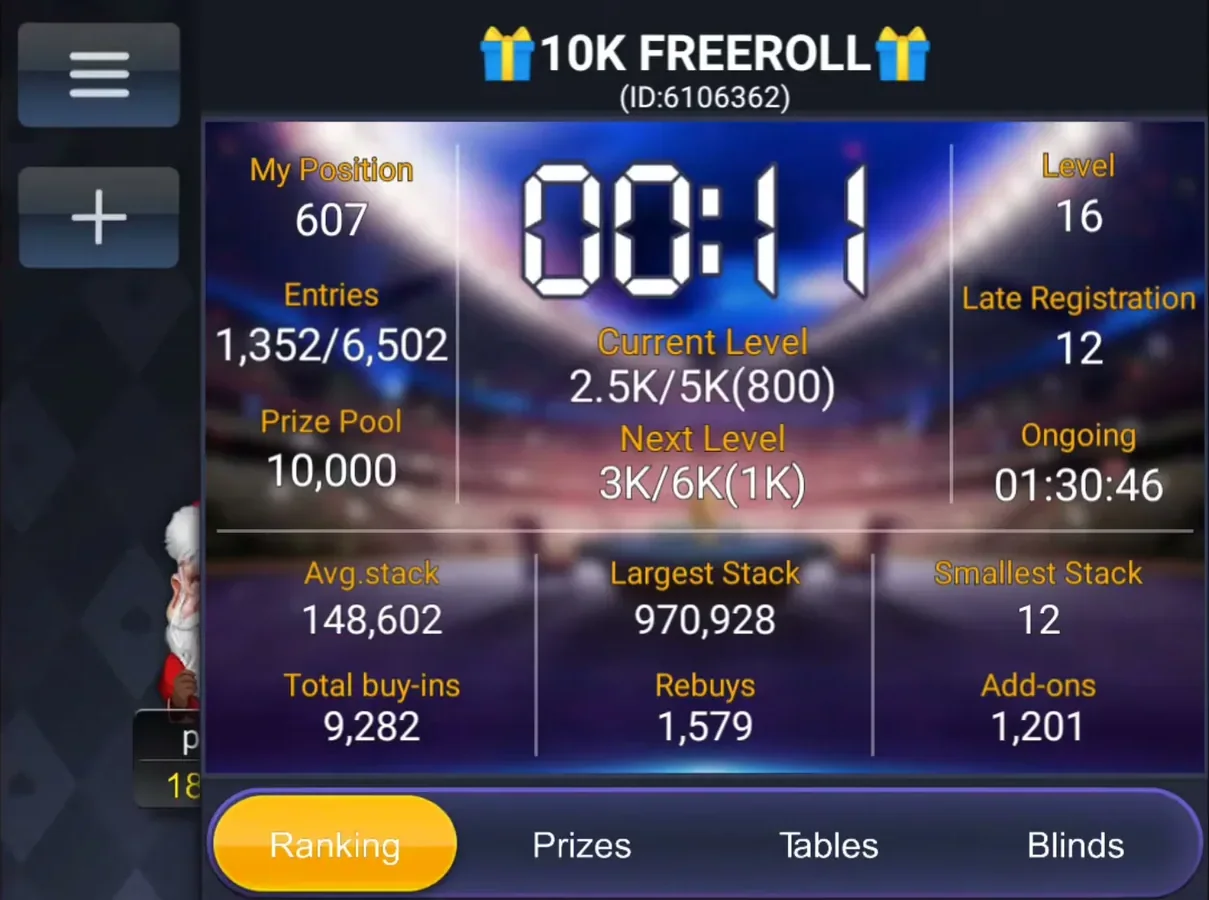
My own sessions back this up. In my club, the PLO games that ran were low-to-mid stakes and softest in the US evening, when the recreational crowd logged on. The lobby and tournament screenshots below are from that club.
Platform traffic is not your traffic
You never see the whole platform. You see the tables of your club and the clubs its union shares a pool with. A headline number of thirty thousand players tells you nothing about whether your game runs at nine in the evening.
Software, Devices and Trackers
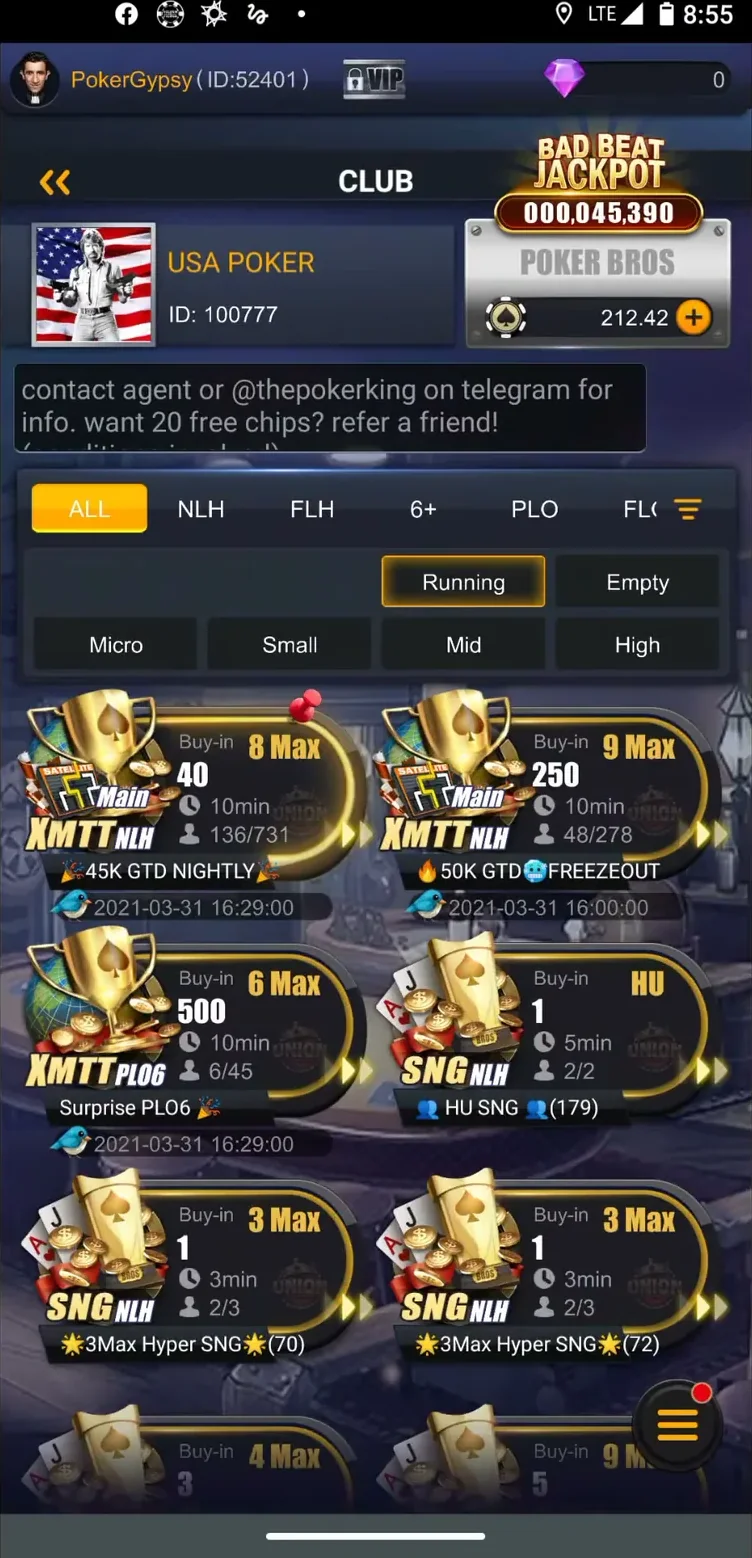
Devices. The PokerBros app is mobile: iOS and Android, with the download free on both stores. There is no native desktop client. To play PokerBros on PC, people use an Android emulator on Windows (BlueStacks, LDPlayer, Nox and Memu are the common ones) or run the app natively on an Apple silicon Mac. From experience: the app is heavy, emulators are demanding, and lag at a poker table costs money. If you can play on a phone or tablet, that's the smoothest path.
Trackers and HUDs. The platform's official policy bans third-party software that provides information about other players, with a permanent ban as the stated penalty. At the same time, some clubs and reviewers openly discuss a PokerBros HUD setup. My collusion section depends on this, so here is my position:
I use DriveHUD to review my own sessions after the fact, importing my hand histories and studying my own play and, as you've seen, patterns at my tables. I do not use it for real-time assistance at the table. That distinction, study tool versus real-time crutch, is the difference between analysing your poker and breaking the rules.
Account security. Never share your login or an account. Protect the email tied to your account with two-factor authentication. Never buy PokerBros diamonds from resellers: the official policy treats it as an offence, and a "cheap diamonds" seller is often a phish. By the platform's rules, account sharing and third-party software mean a permanent ban, with no guarantee for whatever balance was attached to the account. When your balance is already an IOU, a ban turns it into an IOU from someone you just annoyed.
| How you play | Setup | Performance | Caveats |
|---|---|---|---|
| iPhone or iPad | Native app | Best | Vertical table layout takes getting used to |
| Android phone | Native app | Best | Same |
| Windows PC | BlueStacks, LDPlayer, Nox or Memu | Depends on hardware | Emulators are memory hungry; lag costs money |
| Apple silicon Mac | Runs the iOS build natively | Good | The cleanest desktop option |
Third-party software gets accounts banned
The fair play policy prohibits software that gives you information about other players, and the stated penalty is a permanent ban. Reviewing your own hand histories after a session is a different activity from being fed decisions during one. Be clear with yourself about which you are doing.
PokerBros Alternatives Worth Knowing About
Independence includes helping you leave if that's the right call. Your alternatives depend on geography, because an American and a Canadian have different options.
Other club apps: PPPoker, ClubGG, Upoker. Same model: clubs, agents, unions, settlements. So PokerBros vs PPPoker is mostly a question of which clubs you can reach. If the club-agent model is your problem, swapping apps is not a solution. It's the same counterparty risk with a different icon.
Regulated options. In New Jersey, Pennsylvania, Michigan, Nevada or Delaware, licensed real-money poker exists: WSOP.com, BetMGM Poker and other state-regulated rooms, with deposits held by licensed operators, KYC, and regulators who answer complaints. In Ontario, the market under AGCO and iGaming Ontario offers the same to Canadians. If a guaranteed payout matters to you, this is the category that delivers it.
Sweepstakes formats and offshore rooms. Global Poker and ClubWPT-style sweepstakes models, and offshore rooms like Americas Cardroom, Ignition and CoinPoker, each occupy their own legal and practical niche, with their own limits and trust questions; the sweepstakes side is under growing regulatory pressure. I have no affiliate relationship with any of them, so I'll leave the evaluation to you.
My position, as someone who plays in these clubs: if a guaranteed payout is a requirement for you, a club app is the wrong instrument, however soft the games are. Soft fields are the feature. Unprotected balances are the price.
| PokerBros | PPPoker, ClubGG, Upoker | A regulated site | |
|---|---|---|---|
| Who holds your funds | An agent | An agent | The licensed operator |
| Licence | None | None | Yes |
| KYC | None | None | Mandatory |
| Field softness | High | High | Lower |
| Recourse if unpaid | None | None | Operator, then regulator |
The Verdict: Who Should Play Here
This PokerBros review comes down to one formula: the software is audited, the field is soft, and the money is unprotected. PokerBros is playable, enjoyably and profitably, if you knowingly accept counterparty risk and keep only as much in the club as you're willing to lose outright.
Who it's for: experienced players who treat the agent relationship as a business relationship, run the vetting checklist, test withdrawals early, and play the soft fields with their eyes open.
Who it isn't for: anyone depositing large sums; anyone unwilling to vet a counterparty; anyone expecting support in a dispute; anyone in a regulated jurisdiction with licensed options they haven't tried; and anyone who doesn't have their gambling under control. Club apps have no self-exclusion tools, no deposit limits and no cooling-off periods. If that makes you uncomfortable, trust the discomfort.
My own position: I still play in clubs. I keep a small bankroll in each, test every new agent with a small early withdrawal, get rake terms in writing before depositing, and treat every chip as money lent to a stranger. Some of those strangers have been excellent counterparts for years. The system isn't evil. It's unprotected, and now you know where the missing protection would have been.
Last updated: September 2026. Written by John Cox, club-app player since 2020. No affiliate links, no club recruitment, no monetisation on this page.
Play within your limits
Club apps have no self-exclusion tools, no deposit limits and no responsible gambling framework, because they are not regulated products. If your play has stopped being a choice, that matters more than anything else on this page. In the US, the National Council on Problem Gambling runs a confidential helpline on 1-800-GAMBLER.
About this review
Rake, rakeback, traffic and timing figures are market ranges reported by industry sources and club operators, not official platform data, and they change without notice. App Store figures are from the US store, and the Terms and Conditions and Safe and Fair Play quotes were checked against the live pages in September 2026. Ratings shown for other publications are as of September 2026. This review is an editorial opinion based on the author's own play, screenshots and tracker data. It contains no affiliate links and no club referrals.
Frequently Asked Questions
Is PokerBros legit or a scam?
Neither label fits cleanly. The software is legitimate: its RNG is audited by iTech Labs, Gaming Labs (GLI) and BMM Testlabs. But your money is held by a private club agent, not the platform, with no licence or regulator behind it. Players get paid every day and players get burned every day; the difference is usually the agent, not the app. More in Is PokerBros legit?
Is PokerBros rigged?
There is no evidence of a rigged shuffle: the RNG is independently audited, and rigging would destroy a business that profits from rake. What does exist is collusion, coordinated players sharing information, which produces "impossible" hands that feel like rigging but have a different cause. More in The real threat is collusion.
Is PokerBros real money?
Formally, no: the app deals play chips and describes itself as a social gaming platform. In practice, chips are bought from and sold back to club agents at a set rate (commonly 1 chip = $1 in US clubs), so real money moves entirely outside the app, between you and your agent. More in What PokerBros is.
How do you withdraw money from PokerBros?
You request a withdrawal in the app, and your agent pays you outside the platform: typically crypto, Zelle, Venmo or Cash App in the US, or Skrill and Neteller internationally. Most clubs settle weekly, so timing depends on when in the cycle you ask. Test any new agent with a small withdrawal first. More in Deposits and withdrawals.
Is PokerBros legal in the United States?
The app deals play chips, so it's available even in states without regulated online poker, while the real-money layer between players and agents sits outside the platform and its liability. Whether playing for money through an agent is legal where you live depends on state law. Minnesota was cut off in 2020, and winnings are taxable regardless. More in Is PokerBros legal?
Played on PokerBros? Tell us what happened
Your account of how a club or an agent actually treated you is the most useful correction we can get. Messages go to the editors by e-mail. They are not published on this page, and nothing you send appears on the site automatically; if something you write changes the review, we update the review and say when.